17 Jul 2026 — by Flawless Fine Jewellery — Reading time 3 minutes
Tourmaline Gemstones: The Ultimate Guide
Everything you need to know about choosing a tourmaline gemstone—from understanding colour and quality to selecting the perfect stone for a bespoke jewellery commission.
Tourmaline Gemstones: The Ultimate Guide
Introduction
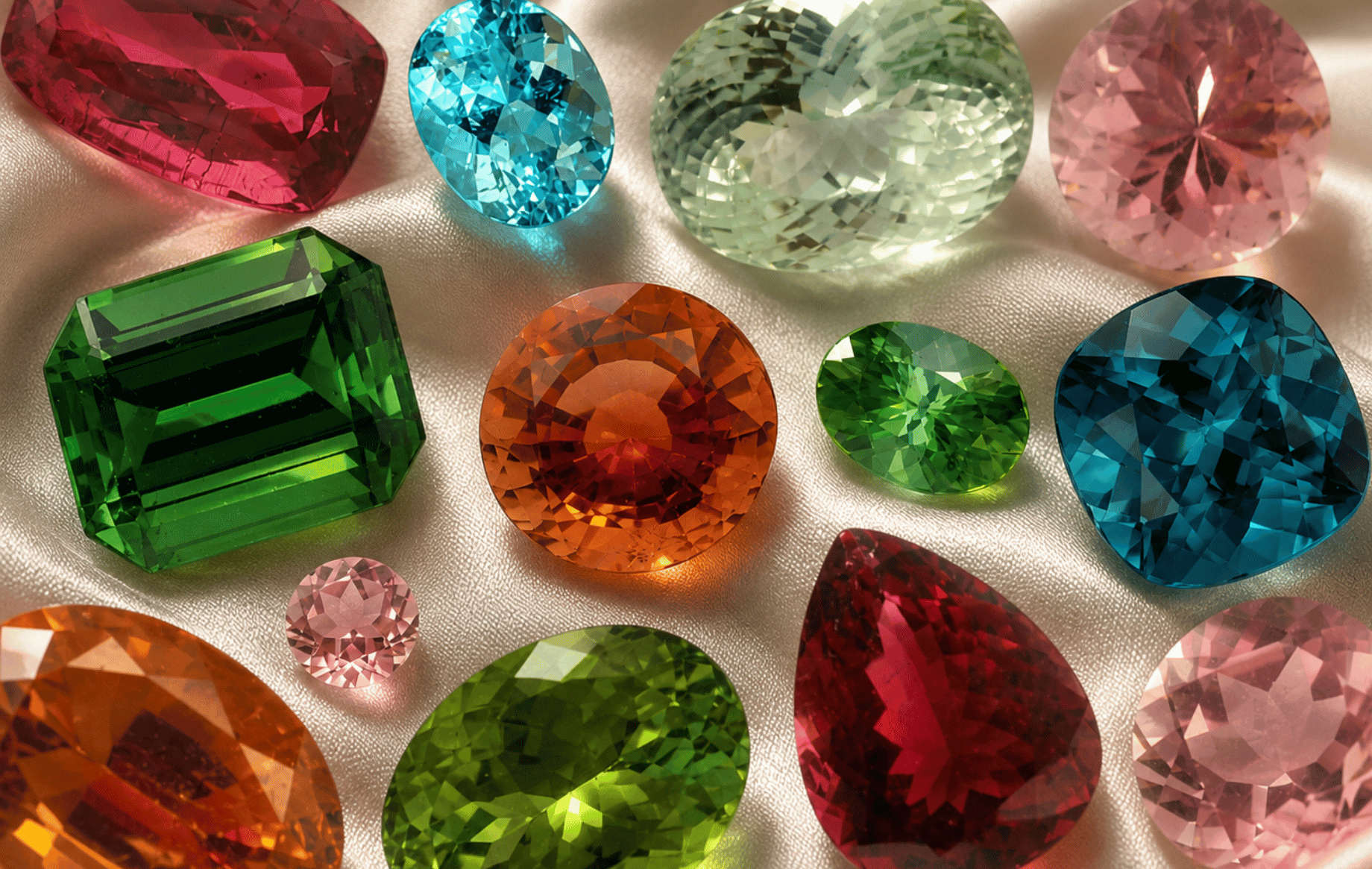
Affectionately known as the rainbow gemstone, tourmaline occurs naturally in more colours than almost any other gem, including striking bi-colour and multicolour crystals. If you’re looking for a gemstone that’s as unique as you are, tourmaline is the perfect option.
By the end of this guide, you'll know…
➤ Why tourmaline is one of the most versatile gemstone families
➤ Which colours are the rarest and most desirable
➤ How to assess quality like a jeweller
➤ Which technical characteristics really matter
➤ How to choose a gemstone you'll still love in decades to come
➤ Why choosing the gemstone first leads to a more individual piece of jewellery

What You'll Learn in This Guide
- Tourmaline Facts at a Glance
- Why Tourmaline Is One of The Most Versatile Gemstone Families
- Understanding the Tourmaline Family
- The Gemmology That Actually Matters
- Why Tourmaline Is Perfect for Bespoke Jewellery
- Caring for Your Tourmaline Jewellery
- Frequently Asked Questions
- Before You Choose Your Tourmaline: A Final Checklist
- Final Thoughts
Tourmaline Facts at a Glance
| Feature | Tourmaline |
| Mineral family | Tourmaline group (a family of closely related minerals) |
| Hardness | 7–7.5 on the Mohs scale |
| Suitable for everyday wear? | Yes, with sensible care and an appropriate setting |
| Typical treatments | Some tourmalines are heat treated to enhance their colour. Any treatments should always be disclosed. |
| Available colours | Almost every colour imaginable, including pink, green, blue, yellow, black and striking bi-colour varieties |
| Birthstone | October |
| Suitable for engagement rings? | Yes, particularly when thoughtfully designed and well protected |
| Best suited to | Bespoke rings, pendants, earrings and one-of-a-kind commissions |
| Most important quality factor | Colour is usually the greatest influence on beauty and value |
| Notable varieties | Rubellite, Indicolite, Paraíba, Chrome and Watermelon Tourmaline |
DISCOVERING TOURMALINE
Why Tourmaline Is One of The Most Versatile Gemstone Families
Few gemstone families offer such an extraordinary combination of colour and personality as tourmaline.
Let’s look at why tourmaline is becoming one of the most treasured coloured gemstones.
A gemstone with almost every colour imaginable
Taking its name from the Sinhalese word ‘toramalli’, which means ‘mixed gems’, tourmaline occurs naturally in a vast range of colours, from vivid pinks and greens to deep blues and blacks.
But perhaps tourmaline’s most stunning characteristic is its ability to display multiple colours in the same stone. Several gemstones can show colour zoning, but tourmaline is famous for crystals that contain distinct colour bands, such as watermelon tourmaline with its green rim and pink centre, which formed over thousands of years as the crystal grew.

Why tourmaline looks different from every angle
One of tourmaline's most fascinating optical properties is pleochroism, which means the gemstone can appear different colours—or different intensities of the same colour—depending on the viewing angle.
Many gemstones are pleochroic, but tourmaline often shows it quite strongly.
Tourmaline is also doubly refractive, which contributes to its lively appearance.
Why collectors and jewellers love tourmaline
Few gemstone families offer such a balance of individuality, rarity, and creative potential, which is why tourmaline continues to fascinate collectors, gemmologists, and jewellery designers alike.
➤ A remarkable spectrum of natural colour – from soft pastels to vivid neon hues.
➤ Endless variety – with different varieties, colour combinations and crystal formations to discover.
➤ Creative freedom – its extraordinary variety makes tourmaline ideal for bespoke jewellery.
➤ Something for every collector and every budget – from accessible everyday gemstones to some of the world's rarest coloured gems.

💎 Did You Know?
Because of its spectacular colour variety, people have often confused tourmaline with other gems. A famous case of mistaken identity is the ‘Caesar’s Ruby’ in the Russian crown jewels, which is actually a red tourmaline, or rubellite.
Understanding the Tourmaline Family
Tourmaline isn’t just one gemstone. To really understand what makes it so beautiful and unique, we need to turn to gemmology.
One gemstone family, many personalities
All tourmalines crystallise in the trigonal crystal system, sharing the same fundamental crystal structure, hardness, pleochroism, and elongated crystal habit.
But tourmaline isn't a single gemstone variety in the way that ruby or emerald are. Instead, it’s actually a group of over 30 closely related minerals.
These distinct groups are called species and are defined by the elements which give the gemstones their colour.
Why Tourmaline Comes in So Many Colours
As tourmaline crystals grow, tiny amounts of elements such as iron, manganese, and copper become incorporated into their crystal structure. These trace elements can dramatically influence how a tourmaline gemstone looks, producing everything from delicate pinks and rich greens to vivid blues and striking bi-colour crystals.
| Trace Element | Typical Colour Produced | Examples | What It Means for You |
| Iron | Green, blue, blue-green, brown and black | Many green tourmalines, Indicolite, Schorl | One of the most common colouring elements, producing a wide range of attractive everyday gemstones. |
| Manganese | Pink, red, orange and yellow | Pink Tourmaline, Rubellite | Responsible for many of tourmaline's warm, vibrant colours, particularly pink and red varieties. |
| Copper | Neon blue and blue-green | Paraíba Tourmaline | Creates the vivid, almost electric colours that make Paraíba one of the world's most sought-after gemstones. |
| Chromium & Vanadium | Intense green | Chrome Tourmaline | Produce exceptionally rich greens that are often compared to fine emeralds. |
| Little or no colouring elements | Colourless | Achroite | Extremely rare and prized for its purity, although less well known than coloured varieties. |
Because several trace elements can be present at the same time—and their concentration can vary within a single crystal—tourmaline can display remarkable colour zoning and even multiple colours in one gemstone.
Tourmaline Varieties Explained
Tourmalines are often grouped by variety, but only if they exhibit these specific colour characteristics:
Rubellite – A pink to red tourmaline that remains red or reddish-pink under different lighting conditions. Simply being a deep pink isn't enough. Fine rubellite is rarer than ordinary pink tourmaline, and is prized for its rich, saturated colour.
Indicolite – This variety of tourmaline has a predominantly blue hue caused by iron traces, ranging from greenish-blue to deep blue. Indicolite tourmaline usually displays strong pleochroism.
Paraíba Tourmaline - This copper-bearing tourmaline displays vivid neon blue, blue-green or green colours. Originally discovered in the Brazilian state of Paraíba, similar material is also found in Mozambique and Nigeria.
Chrome Tourmaline – Often compared with emerald because of its intense, saturated colour, this green tourmaline is primarily coloured by chromium and/or vanadium.
Watermelon Tourmaline – A natural colour pattern which forms during its growth, watermelon tourmaline has a red or pink centre with green around the outside.
Achroite – Pure tourmaline is colourless, lacking the trace elements that produce the rainbow of colours in other varieties. Achroite is extremely rare but less sought after than coloured tourmaline.
Schorl – This black tourmaline is coloured by a high iron content and is the most common form of the gemstone. It’s normally used in carvings and decorative objects.

Why some colours are exceptionally rare
Although we find tourmaline in an extraordinary range of colours, not all colours occur with the same frequency. The rarest varieties require very specific geological conditions and unusual combinations of trace elements during crystal growth. Fine examples of these beautiful gemstones are found in only a few locations worldwide, making them especially scarce and sought-after.
The rarest tourmaline varieties are:
Paraíba Tourmaline – Often regarded as one of the world's rarest and most valuable coloured gemstones. Exceptional Paraíba tourmalines can command prices per carat comparable to, or even exceeding, fine rubies, sapphires, and emeralds.
Rubellite – High-quality rubellite rivals even rubies for rarity. To be considered a true rubellite, the gemstone must be a deeply saturated red, purplish-red, or shocking pink that stays vivid in low or artificial light.
Indicolite - Natural blue tourmaline is significantly less common than green or pink tourmaline, making fine indicolite one of the most sought-after blue gemstones outside sapphire.
Chrome Tourmaline – Found almost exclusively in East Africa, chrome tourmaline has an intense, vivid green that rivals high-grade Colombian emerald for colour.
💎 Did You Know?
Rarity alone doesn't determine value. A beautiful green tourmaline with exceptional colour and brilliance may be more desirable than a rarer variety with poor colour or a lacklustre cut. That's why experienced jewellers evaluate each gemstone on its individual merits, not just its name.
LEARNING TO JUDGE QUALITY
The Gemmology That Actually Matters
Tourmaline is a fascinating gemstone, but how do its specific properties and characteristics influence your finished piece of jewellery, and what should you be looking for in a high-quality gem?
Hue, tone, and saturation
At Flawless Fine Jewellery, we judge a tourmaline’s colour by three important factors.
Hue: This relates to the stone’s main colour. We look for stones that have the purest, most distinct hue for our collections.
Tone: When we talk about tone, we mean whether the stone’s colour is light or dark. A stone whose tone is too light can look washed out, whereas a stone that’s too dark can look dull and lifeless. A medium tone will allow your tourmaline’s colour to radiate.
Saturation: Our favourite quality – saturation refers to the colour’s intensity. A tourmaline with high saturation will look bright and alive. Low saturation can create a grey or brown hue.

Pleochroism
Pleochroism means a tourmaline can appear different colours or different intensities of colour depending on the viewing angle. That's why it's worth viewing a tourmaline from several angles before buying—a beautifully cut gemstone should remain lively and attractive no matter which way you look at it.
Expert cutters carefully orientate a tourmaline before faceting so that its most attractive colour is displayed when viewed face-up. Two gemstones cut from the same crystal can therefore look surprisingly different.
Cut
An expert cut does more than just shape the stone. It reveals your tourmaline’s inner beauty and allows its colour to shine. A skilled cutter can minimise the appearance of inclusions, maximise a stone’s brilliance, and choose exactly where to cut to show off tourmaline’s pleochroism to its best advantage.
A poor cut can also create 'extinction'—dark areas where light fails to return to the eye—or 'windowing', where the centre of the gemstone appears transparent because light passes straight through it. A well-cut tourmaline should display lively colour and brightness across the whole gemstone.
Learning to judge the quality of a stone’s cut can become very technical, but at Flawless Fine Jewellery, we encourage you to simply turn the stone in the light. You’ll notice a well-cut tourmaline immediately.

What to look for
✔ The gemstone looks bright rather than dull.
✔ Colour appears even across the stone.
✔ Light reflects evenly as you move it.
✔ The overall shape feels balanced and well proportioned.
Clarity
We judge a gemstone’s clarity on the presence or absence of internal features called inclusions.
Natural inclusions are part of how a tourmaline forms; in fact, some varieties, such as rubellite, naturally contain more inclusions than others. But these inclusions should never distract from a tourmaline’s beauty.
If you want to buy a tourmaline the way we do, look for a gemstone that appears bright and lively to the naked eye, rather than focusing on finding a flawless stone.
How important is carat weight?
Carat weight measures how much a tourmaline weighs, not how beautiful it is. While larger gemstones are generally rarer and can command higher prices, colour, cut and overall appearance usually have a much greater influence on a tourmaline's desirability.
What to look for
✔ Choose beauty before size.
✔ Compare gemstones side by side whenever possible.
✔ Ask yourself which stone catches your eye first.
✔ Remember that colour and cut usually have a greater impact than carat weight.
Should I Be Concerned About Treatments?
Some tourmalines are treated to improve their colour or clarity, most commonly through heat treatment. There is no need to worry about this. At Flawless Fine Jewellery, we will always disclose if a gemstone has been treated and will be happy to talk to you about it in more detail.
💎 Did You Know?
Heat treatment has been accepted in the gemstone trade for centuries. Some of the world's most beautiful sapphires, rubies, aquamarines and tanzanites have been heat treated to enhance their natural colour. The important thing is that any treatment is permanent and fully disclosed by the jeweller.
Does Origin Matter?
Tourmaline is mined in many parts of the world, however certain regions have become famous for producing particular varieties. Brazil is renowned for the original Paraíba tourmalines, Mozambique also produces exceptional copper-bearing gems, Afghanistan is known for beautiful pink and green gemstones, while Nigeria and Madagascar yield tourmalines in an impressive range of colours.
Although origin can add to a gemstone’s story, it is only one factor in judging quality, and should always be considered alongside colour, cut, and overall beauty.
🔍 From the Jeweller's Bench
We never judge a tourmaline by one characteristic alone. A gemstone with an extraordinary colour can easily outweigh origin, minor inclusions, or a slightly smaller size. It's always the overall balance that makes a gemstone truly special.
FROM GEMSTONE TO BESPOKE JEWELLERY
Why Tourmaline Is Perfect for Bespoke Jeweller
Bespoke jewellery is where tourmaline shines. Its extraordinary range of colours and distinctive characteristics allow you to create a piece of jewellery that perfectly reflects your individual style and personality.
Choosing the gemstone first
Whenever we design a piece of jewellery, we always start with the gemstone. It’s the heart of your piece, and the colour, cut, and shape of your gemstone will influence everything that comes after.

How shape influences design
The shape of a tourmaline influences far more than its appearance. It affects how the gemstone sits in a setting, the style of jewellery it suits, and the overall balance of the finished design.
| Shape | Style | Best For | Visual Effect | Things to Consider |
| Oval | Classic | Engagement rings | Maximises apparent size | One of the most versatile shapes. |
| Cushion | Vintage-inspired | Dress rings | Soft sparkle | Suits many tourmaline colours. |
| Emerald Cut | Elegant | Engagement rings | Highlights colour and clarity | Works particularly well with cleaner stones. |
| Pear | Romantic | Pendants & rings | Graceful, elongating effect | Requires a protective setting around the point. |
| Round | Traditional | Solitaires | Maximum symmetry | Less common in tourmaline due to its naturally elongated crystal habit. |
| Freeform | Contemporary | Bespoke designs | Celebrates the natural crystal | Perfect for one-of-a-kind commissions. |
🔍 From the Jeweller's Bench
A skilled cutter will work with the gemstone’s natural properties. Tourmaline’s elongated, prismatic crystal habit lends itself well to long, rectangular shapes. Tourmaline crystallises in the trigonal crystal system, naturally forming long, prismatic crystals with distinctive vertical striations. This crystal habit influences the shapes in which tourmalines are cut and is one of the reasons elongated cuts such as emerald, oval and pear shapes are so common.
Matching colour to precious metal
The precious metal you choose does more than just hold the gemstone in place—it frames its colour. The right combination can enhance a tourmaline's natural beauty, making it appear brighter, richer, or more vibrant.
| Metal | Works Particularly Well With | Creates This Look | Ideal For |
| Yellow Gold | Green, Rubellite, Watermelon | Rich, warm contrast | Traditional and vintage-inspired designs |
| White Gold | Pink, Rubellite, Peach | Crisp, contemporary appearance | Modern engagement rings |
| Rose Gold | Blue, Pink, Green | Soft, romantic warmth | Feminine and vintage-inspired jewellery |
| Platinum | Paraíba, Blue, Green | Clean, understated luxury | Premium gemstones and heirloom jewellery |
When commissioning bespoke jewellery, viewing the gemstone alongside different metals is often the easiest way to appreciate how dramatically the overall look can change.
Designing for beauty and everyday wear
The best jewellery design balances beauty with practicality. Choosing the right setting and design helps protect your tourmaline while ensuring it's comfortable to wear and suits your lifestyle.
Key points:
➤ Consider how often you'll wear the piece.
➤ Lower-profile settings are ideal for everyday wear.
➤ Bezel settings offer more protection, while claw settings maximise light and visibility.
🔍 From the Jeweller's Bench
When we design a piece of jewellery, we're thinking years ahead. The right setting should not only showcase the tourmaline beautifully today but also protect it so it can be enjoyed for decades to come.
LIVING WITH YOUR TOURMALINE
Caring for Your Tourmaline Jewellery
Now you’ve chosen your perfect tourmaline, follow our top tips to keep it looking bright and vibrant for years to come.
How to keep your tourmaline looking its best
Tourmaline is durable enough for everyday jewellery, but like all coloured gemstones it benefits from thoughtful care. Although it's harder than many gemstones, it isn't as resistant to scratching as diamond or sapphire, so a little attention helps preserve the crisp facet edges and polished surface that give it its sparkle.
Keep it looking vibrant by:
➤ Cleaning gently with warm water, mild soap, and a soft brush
➤ Drying with a lint-free cloth
➤Cleaning more frequently if you wear your tourmaline every day

Store it separately
Tourmaline is hard enough to be suitable for everyday wear, but that doesn’t mean that harder gemstones can’t scratch it.
To keep your tourmaline safe you should
➤ Store it separately in a soft pouch or a lined jewellery box
➤ Don’t allow diamonds or sapphires to rub against its surface
Don't forget the setting
For bespoke jewellery, the setting is just as important as the gemstone.
➤ Check claws occasionally for signs of wear.
➤ Have rings professionally inspected every year or two.
➤ If a gemstone begins to feel loose, stop wearing it until it's checked.
Professional cleaning
A professional clean and inspection can restore brilliance while ensuring the setting remains secure. At Flawless Fine Jewellery, we offer complimentary cleaning and inspection at both our Hatton Garden and Manchester stores.
Frequently Asked Questions
Q: Where is tourmaline found?
Tourmaline is found in many parts of the world. Brazil is particularly famous for the original Paraíba tourmalines, while countries including Mozambique, Nigeria, Afghanistan and Madagascar are renowned for producing exceptional gemstones in a wide range of colours.
Q: Is tourmaline a precious stone?
No. Traditionally, experts classified tourmaline as a semi-precious gemstone; only considering diamonds, rubies, sapphires, and emeralds as precious gemstones. However, this traditional distinction doesn't reflect beauty or value. Exceptional tourmalines, such as fine Paraíba tourmalines, can be rarer and more valuable than many precious gemstones.
Q: Why does October have two birthstones?
October is one of the few months with two official birthstones: opal and tourmaline. Opal was the traditional birthstone for October, while tourmaline was added in the early 20th century. Today, both are recognised as official October birthstones, allowing you to choose the gemstone that best suits your style and personality.
Q: What is the rarest type of tourmaline?
Many consider Paraíba tourmaline to be the rarest and most valuable type of tourmaline. Its vivid neon blue and blue-green colours make exceptional examples highly sought after by collectors and jewellers alike.
Q: Can tourmaline change colour?
One of tourmaline’s most distinctive features is its pleochroism. This means that some tourmalines can appear slightly different in colour or intensity depending on the viewing angle and lighting conditions.
Q: What should I look for when buying tourmaline?
Start with the colour that appeals to you most, then consider cut, clarity and overall brilliance. A smaller tourmaline with exceptional colour is often a better choice than a larger gemstone with a dull appearance.
Q: Why buy a loose tourmaline instead of a ready-made ring?
Buying a loose tourmaline allows you to choose the exact gemstone before designing the jewellery around it. It's the ideal option if you're commissioning a bespoke engagement ring or creating a one-of-a-kind piece that reflects your personal style.
Before You Choose Your Tourmaline: A Final Checklist
□ Do I genuinely love the colour?
□ Have I seen it in different lighting?
□ Does the cut bring it to life?
□ Does the shape suit my design?
□ Have treatments been explained?
□ Am I choosing beauty over size?
□ Can I imagine enjoying this in twenty years?
Final Thoughts
A remarkable tourmaline isn't defined solely by rarity or price, but by the connection you feel with it. When you begin with the right gemstone, the jewellery you design becomes something truly personal.




Need help choosing ?
We're happy to help