3 Jul 2026 — by Flawless Fine Jewellery — Reading time 3 minutes
Birthstones by Month and What They Mean for Your Engagement Ring
Birthstones by Month and What They Mean for Your Engagement Ring
A birthstone turns a ring into something deeply personal. Long before a clear diamond became the expected centre stone, couples chose stones tied to a birth month, a shared memory or a quiet superstition, and that tradition is enjoying a real revival.
A birthstone engagement ring carries colour, history and meaning in a way a colourless stone simply cannot, and many of the most beautiful birthstones are every bit as hard-wearing as a diamond. Whether you want a stone that marks the month you met, the month of the proposal, or simply a colour you have always loved, there is a birthstone to suit.
This guide walks through all twelve months, what each stone is said to mean, how it behaves in daily wear, and how to set it so it lasts a lifetime. It is written for couples choosing an engagement ring, so the focus throughout is on durability, beauty and the small practical choices that make a coloured stone a joy to wear rather than a worry.

Where birthstones come from
The idea of a stone for each month is ancient, with roots in scripture and folklore. Many historians trace it to the breastplate of Aaron described in the Book of Exodus, which carried twelve stones, later linked to the twelve months and the twelve signs of the zodiac. For centuries people wore the stone of the moment rather than only their own, rotating gems through the year for luck and protection.
The list most people recognise today was standardised in the twentieth century, when jewellers' associations agreed a modern set of birthstones to bring some order to a tangle of regional traditions. That list has been gently updated since, which is why several months now offer more than one stone. For you, that flexibility is good news, because it means you can choose the colour, the character and the hardness that suit your hand and your life.

The twelve birthstones, month by month
January is garnet, a deep, glowing red that symbolises devotion, loyalty and constancy. Garnet is durable enough for everyday wear and offers a romantic alternative to a ruby at a gentler price. February is amethyst, a regal purple quartz linked with calm, clarity and a clear head, and a lovely choice for anyone drawn to violet tones without the rarity of a purple sapphire.
March is aquamarine, a soft sky-blue stone that represents tranquillity, serenity and lasting love, its cool clarity echoing calm water. April is the diamond, prized for its fire and its unmatched hardness, the natural choice for a ring meant to last forever. If you love April but want a little warmth, a yellow diamond offers the same durability in a sunlit, canary colour.


July is ruby, the most romantic of all birthstones, standing for love, passion and vitality. As a member of the corundum family it is superbly hard-wearing, second only to diamond. August offers peridot and spinel. Peridot brings a fresh olive green, while spinel is increasingly admired for its rich reds, pinks and greys and its excellent durability, a genuine connoisseur's stone that deserves more attention than it gets.

September is sapphire, which reaches far beyond classic blue into teal, green, pink, purple and the rare pink-orange padparadscha. At 9 on the Mohs hardness scale it is one of the best of all stones for daily wear, which is why it has been a favourite for engagement rings for generations. October is opal or tourmaline. Opal is mesmerising, with its dancing play of colour, but it is soft and needs gentle handling, while tourmaline spans an extraordinary range of colours and is a more practical everyday option.


Choosing a birthstone you can wear every day

Diamond sits at 10, sapphire and ruby at 9, and topaz and spinel at around 8, which makes all of these excellent, low-worry choices.
Softer or more delicate stones such as emerald, tanzanite, opal, moonstone and pearl are still beautiful options, and plenty of people wear them happily for years. The trick is to protect them. A halo setting surrounds the centre stone with a ring of small diamonds that take the knocks first, while a bezel setting wraps the stone in a smooth rim of metal that shields its edges. Both let you enjoy a softer birthstone with far more peace of mind.
Settings that flatter colour
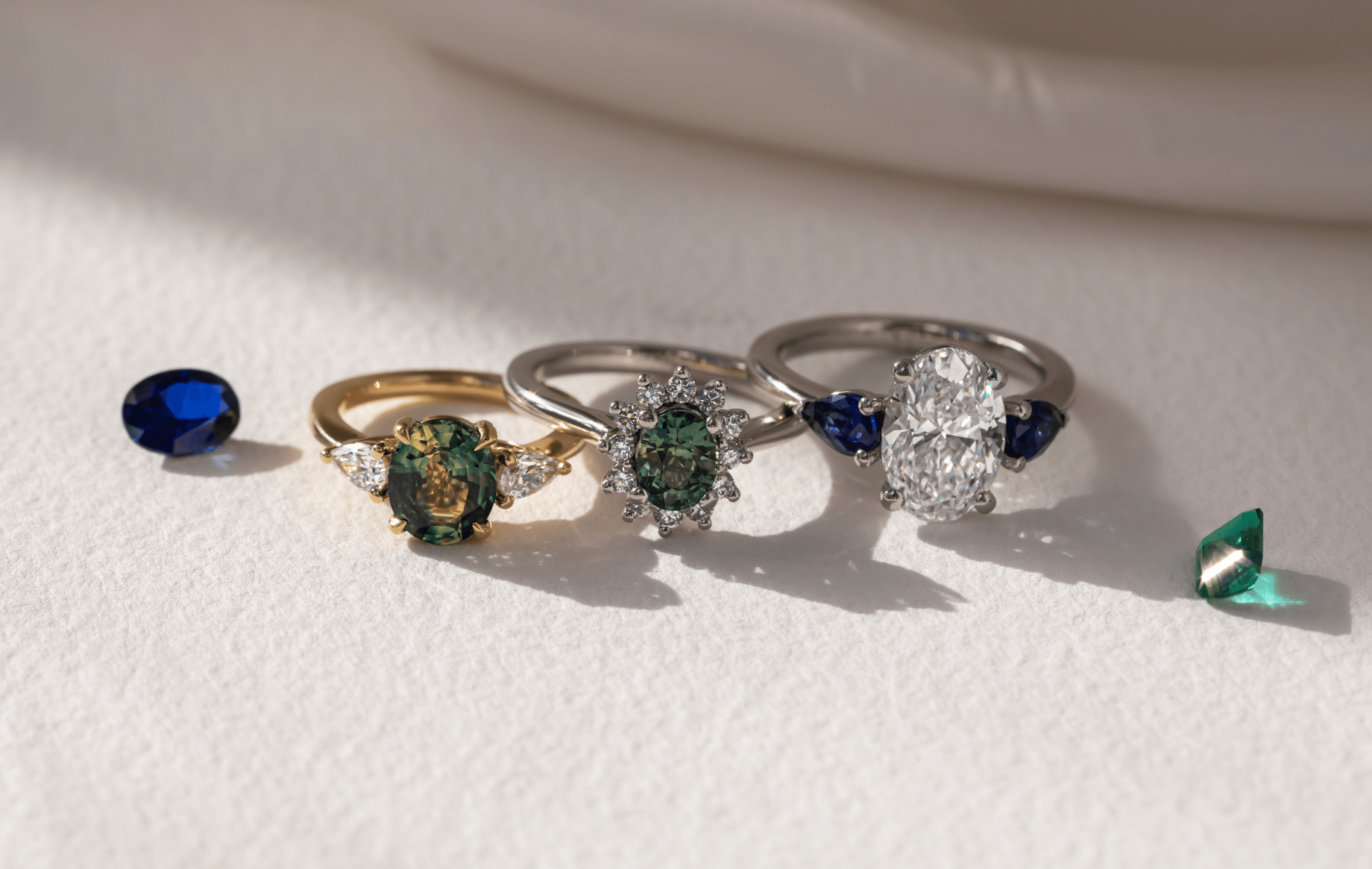
Metal choice changes how a colour reads. Cool white metals such as white gold and platinum make blues, greens and violets look crisp and contemporary, while warm yellow gold deepens reds, oranges and yellows and gives the whole ring a vintage glow. Rose gold flatters pinks and peaches beautifully. There is no wrong answer, only the look you love, and seeing a stone against different metals in person is the quickest way to decide.
The cut matters too. Coloured stones are often cut to show their colour at its richest rather than only to maximise sparkle, so an oval, cushion or emerald cut can make a hue look deeper and more even. A larger, well-proportioned stone in a simple solitaire setting lets the colour speak for itself, while a cluster or halo adds extra brilliance around it.

Making it personal
A birthstone ring is a chance to tell your own story. You can set your own birth month, your partner's, or both. A toi et moi design, with two stones sitting side by side, is a romantic way to combine two birth months, while a three-stone ring can frame a central diamond with a coloured birthstone on either side, or tell a past, present and future story in colour.
Because every ring can be made bespoke, the stone, the cut, the metal and the setting can all be chosen around the date and the person who matter to you. You might even hide a tiny birthstone on the inside of the band as a private detail only the two of you know about, a small touch that makes the ring feel truly one of a kind.
A birthstone engagement ring is rarely about following a rule and almost always about meaning. Choose a colour you are drawn to, set it so it lasts, and you will have a ring that feels personal every time you look at it.

Caring for a coloured birthstone
A coloured stone rewards a little routine care, and the harder gems make this easy. Sapphire, ruby, spinel and topaz can be cleaned at home with warm water, a drop of mild washing-up liquid and a soft brush, then rinsed and patted dry, which lifts away the lotion and skin oils that dull a stone over time. A gentle clean every week or two keeps the colour bright and the sparkle alive, and it takes only a couple of minutes.
Softer or treated stones ask for a gentler hand. Emeralds are often oil-treated, so they dislike ultrasonic cleaners, heat and harsh chemicals, while opal, pearl and tanzanite prefer to avoid knocks and sudden temperature changes. Whatever the stone, take the ring off for the gym, gardening and swimming, store it apart from harder gems so nothing scratches, and have the setting checked once a year so a loose prong is caught long before a stone can be lost.
Popular birthstone pairings
Some of the loveliest birthstone rings bring two months together. A blue sapphire and a white diamond make a classic, hard-wearing pair, while a ruby and a diamond glow with warmth and contrast.
For something softer, a pink sapphire sits beautifully beside a diamond in rose gold. If both stones are durable, you can wear the pairing with complete confidence, and if one is more delicate, a protective setting keeps it safe. Pairing two birth months is a quietly romantic way to put both of you into a single ring.
Explore our gemstone engagement rings, or book a complimentary consultation at our Hatton Garden showroom in London or in Manchester to see birthstones in person and compare them in the light.





Need help choosing ?
We're happy to help