12 May 2026 — by Flawless Fine Jewellery — Reading time 3 minutes
What is Tanzanite? A Complete Gemstone Guide
What is Tanzanite? A Complete Gemstone Guide
In the world of fine gemstones, rarity defines true luxury. And few stones embody that principle more completely than tanzanite: a gemstone born from a singular moment in geological history and found in only one location on Earth.
With its mesmerising interplay of sapphire blues and velvety violets, tanzanite offers a depth of colour that feels both timeless and unmistakably modern. But beyond its beauty lies a story of discovery, scarcity, and rising desirability.
Here’s everything you need to know about this extraordinary gemstone.

- What is Tanzanite and How Was It Discovered?
- Why is Tanzanite So Rare?
- The Unique Geology Behind the Gemstone
- The Captivating Colour of Tanzanite
- How Lighting Affects Tanzanite's Appearance
- Understanding Tanzanite Grading
- The Importance of the Cut
- The Role of Heat Treatment
- Tanzanite as a December Birthstone
- Designing Jewellery with Tanzanite
- Comparing Tanzanite to Blue Sapphire
- The Investment Potential of Tanzanite
- FAQ's
What is Tanzanite and How Was It Discovered?
So, what is tanzanite?
The story of tanzanite is unlike that of almost any other gemstone. While diamonds and emeralds have histories stretching back thousands of years, tanzanite was completely unknown to the world until 1967.
The discovery took place in the Merelani Hills, a small region near Arusha in northern Tanzania, resting in the shadow of Mount Kilimanjaro. According to the most widely accepted account, Maasai herders were tending their livestock when they noticed vibrant blue crystals scattered on the ground. They alerted a local prospector named Manuel d'Souza, who initially believed he had stumbled upon a new deposit of sapphires.
However, gemological testing soon revealed that these stones were not sapphires at all. They were a remarkably vibrant, blue-violet variety of a mineral called zoisite. Recognising the extraordinary potential of this new gem, Tiffany & Co. agreed to become its main distributor. They decided that "blue zoisite" lacked the necessary romance, so they named the stone "tanzanite" in honour of its exclusive country of origin, launching it to the world in 1968.

Why is Tanzanite So Rare?
What truly sets tanzanite apart is its exceptional rarity. The geological conditions required to create tanzanite were so unique and specific that the gemstone is found in only one place on Earth: a tiny strip of land measuring just four kilometres long and two kilometres wide in Tanzania.
Because of this incredibly limited geographic footprint, tanzanite is often described as being a thousand times rarer than diamonds. While diamonds are mined in multiple countries across several continents, every single authentic tanzanite in the world comes from this one small location.
And perhaps most importantly, this rarity comes with a defining reality that tanzanite will not last forever. Recent studies suggest that the tanzanite deposits in the Merelani Hills could be depleted within the next two decades. This impending scarcity has made tanzanite increasingly sought after, not just for its beauty, but as a collector's item and a potential investment piece.
The Unique Geology Behind the Gemstone
To truly understand what makes this stone so special, it helps to look at the geology. The formation of tanzanite occurred roughly 585 million years ago during a massive tectonic event that created Mount Kilimanjaro. The intense heat and pressure from this event forced specific minerals together in a way that has never been replicated anywhere else on the planet.
The presence of vanadium within the zoisite mineral structure is what gives tanzanite its potential for blue and violet colours. However, it was the specific combination of this vanadium with the extreme geological forces of the region that created the perfect storm for tanzanite to form. This is why geologists often refer to the creation of tanzanite as a "geological phenomenon," making it a true marvel of the natural world.
The Captivating Colour of Tanzanite
The most defining characteristic of tanzanite is its breathtaking colour. It is famous for its rich, multidimensional hues that bridge the gap between deep blue and vibrant violet.
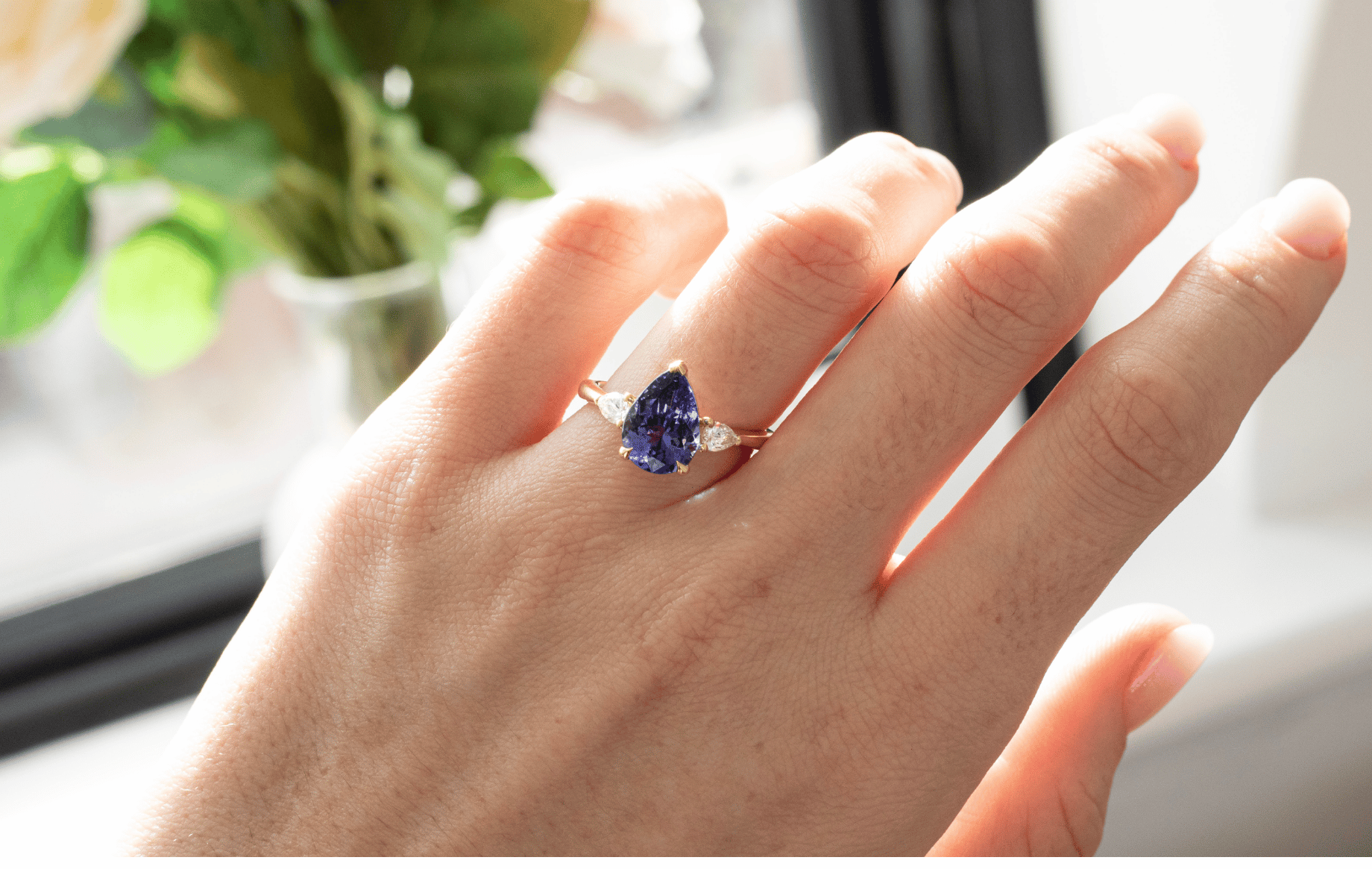
This unique colour profile is due to a gemological property known as pleochroism (specifically, trichroism). This means that the gemstone actually displays three different colours (blue, violet, and burgundy or red) depending on the angle from which it is viewed and the lighting conditions. In daylight, tanzanite often appears more blue, while incandescent lighting tends to bring out its violet and purple tones.
When a gem cutter prepares a piece of rough tanzanite, they must carefully decide how to orient the stone to maximise its best colour. Cutting the stone to emphasise the pure, sapphire-like blue usually results in a smaller finished gem, as more of the rough material must be sacrificed. Cutting to emphasise the violet-purple hues allows the cutter to retain more weight. As a result, stones that display a strong, dominant blue are generally rarer and command a higher price.

How Lighting Affects Tanzanite's Appearance

One of the most enchanting aspects of owning a tanzanite is watching how it responds to different environments. Because of its pleochroic nature, the stone can look remarkably different depending on where you are.
Under the cool, crisp light of a sunny day, the deep blue tones of the stone tend to dominate, often drawing comparisons to the finest sapphires. However, when you move indoors under warm, incandescent lighting, such as the soft glow of a restaurant or a candlelit room, the stone undergoes a subtle transformation, revealing rich flashes of violet, purple, and sometimes even hints of burgundy.
This dynamic, ever-changing personality is part of what makes tanzanite so captivating to wear. It is a gemstone that never looks exactly the same twice, offering a constant source of fascination for the wearer.
Understanding Tanzanite Grading
Like diamonds, tanzanite is evaluated based on the 4Cs: colour, clarity, cut, and carat weight. However, because it’s a coloured gemstone, colour is by far the most important factor in determining its value.
The most prized tanzanites exhibit a deep, intensely saturated violetish-blue colour. Paler stones, which might appear more like a soft lilac or periwinkle, are more common and therefore more affordable. It’s worth noting that the deepest, most saturated colours are typically only found in larger stones, usually those weighing over five carats. Smaller stones naturally tend to have a lighter, more pastel appearance.
In terms of clarity, tanzanite is generally expected to be "eye-clean." This means that when you look at the stone with the naked eye, you should not be able to see any visible inclusions or flaws. Because tanzanite forms in relatively clean crystals, stones with visible inclusions are significantly less valuable.

The Importance of the Cut

While colour is paramount, the cut of a tanzanite plays a crucial role in how that colour is displayed. A skilled lapidary (gem cutter) must carefully study the rough stone to determine the best orientation for cutting.
Because tanzanite is pleochroic, the cutter must decide whether to orient the table (the flat top facet of the gem) to show more blue or more violet. This decision is a delicate balancing act between maximising the most desirable colour and retaining as much carat weight as possible.
A well-proportioned cut allows light to reflect beautifully within the stone, creating the brilliant sparkle that brings its colour to life. By contrast, a poorly cut tanzanite, even one with excellent inherent colour, can appear dull or lifeless, or it may exhibit a “window”: a transparent area in the centre where light escapes rather than returning to the eye.
The Role of Heat Treatment
When discussing what tanzanite is, it’s important to address how it gets its signature colour. In its natural, rough state, tanzanite is typically a brownish-burgundy colour. The vibrant blues and violets are almost always the result of heat treatment.
The rough stones are gently heated to around 600 degrees Celsius. This process mimics the natural geothermal heating that occurred in the earth to create the very first blue crystals found by the Maasai herders. The heat alters the stone's oxidation state, removing the brown and yellow tones and permanently revealing the blue and violet hues beneath.
This heat treatment is a standard, universally accepted practice in the gemstone industry. It does not weaken the stone, and the resulting colour is completely stable. Because virtually all tanzanite on the market has been heated, it does not negatively affect the stone's value. In fact, finding a naturally blue, unheated tanzanite is exceptionally rare.
Tanzanite as a December Birthstone
For decades, the traditional birthstones for December were turquoise and zircon. However, in 2002, the American Gem Trade Association made a historic decision to add tanzanite to the official birthstone list.
This was the first time the birthstone list had been amended since 1912, a testament to the profound impact tanzanite had made on the jewellery world in such a short time. Today, it is widely celebrated as the primary birthstone for December, making it a deeply meaningful gift for those born in that month, or for couples celebrating a December anniversary.
Designing Jewellery with Tanzanite
Tanzanite's striking colour makes it a spectacular choice for fine jewellery. It pairs beautifully with both white metals, like platinum and white gold, which enhance its cool blue tones, and yellow or rose gold, which provide a rich, warm contrast.
At Flawless Fine Jewellery, we often incorporate tanzanite gemstones into our bespoke jewellery designs. It looks particularly stunning when surrounded by a halo of white diamonds, as the brilliant sparkle of the diamonds perfectly frames and elevates the deep, velvety colour of the centre stone.
While it is a popular choice for pendants and earrings, many of our clients also choose tanzanite for engagement rings. If you are considering a tanzanite engagement ring, it is a beautiful way to create a piece that is truly distinctive and personal. However, it does require a little more thought regarding the setting and how you plan to wear it. You might also consider pairing it with a custom wedding ring designed to sit flush against the protective setting.
Comparing Tanzanite to Blue Sapphire
Because of its colour, tanzanite is most frequently compared to blue sapphire. If you are torn between the two, the table below outlines the key differences to help you make an informed decision.
| What is Tanzanite? How It Compares With Blue Sapphire | ||
| Feature | Tanzanite | Blue Sapphire |
| Colour Profile | Blue with strong violet/purple undertones | Pure blue, sometimes with slight green or violet hints |
| Hardness (Mohs Scale) | 6.5 to 7 (Requires careful wear) | 9 (Excellent for everyday wear) |
| Rarity | Found in only one location globally | Mined in multiple countries worldwide |
| Price Point | Generally more accessible per carat | Typically higher priced, especially for fine quality |
| Light Interaction | Highly pleochroic (shows different colours | Less pronounced pleochroism |
Ultimately, the choice between the two comes down to your personal priorities. If durability for a highly active lifestyle is your main concern, sapphire is the traditional choice. But if you are captivated by a unique, multidimensional colour and the romance of extreme rarity, tanzanite is unmatched.
The Investment Potential of Tanzanite
Beyond its aesthetic appeal, many people are drawn to tanzanite for its potential as an investment. Because the global supply is restricted to a single, depleting source, the basic principles of supply and demand suggest that its value will likely increase over time.
As the Merelani mines dig deeper, the cost of extraction rises, and the yield of high-quality stones decreases. When the mines eventually close, tanzanite will become a "heritage gemstone," meaning the only way to acquire it will be through the secondary market or from existing private collections.
While we always advise our clients to buy jewellery first and foremost because they love it, the finite nature of tanzanite certainly adds an intriguing element of long-term value to your purchase.
If you’re considering adding a truly rare gemstone to your collection, we invite you to take a look at our tanzanite jewellery. Each stone offers the opportunity to create something entirely your own, designed around its unique colour, character, and rarity.

What is tanzanite made of?
Tanzanite is a blue-violet variety of the mineral zoisite. Its unique colour is caused by the presence of small amounts of vanadium within the crystal structure, which is then activated by heat.
Is tanzanite more expensive than diamonds?
No, despite being significantly rarer than diamonds, tanzanite is generally more affordable per carat. This makes it an excellent choice for those looking for a larger, high-impact gemstone without the premium price tag of a comparable diamond.
Can I wear a tanzanite ring every day?
You can, but it requires care. Because tanzanite is softer than diamonds and sapphires, it is more prone to scratching and chipping. If you plan to wear it daily, we recommend choosing a protective setting, such as a bezel or halo, and removing the ring during heavy physical activities.




Need help choosing ?
We're happy to help