20 Apr 2026 — by Flawless Fine Jewellery — Reading time 3 minutes
Mozambique Rubies vs Burmese Rubies: What’s the Difference?
Mozambique Rubies vs Burmese Rubies: What’s the Difference?
Introduction
Burma and Mozambique, what do these two distant places have in common? Rubies. What’s the difference? The ancient mines of Mogok, nestled deep in the highlands of Burma, and the vast deposit at Montepuez in Mozambique produce the best Rubies in the world.
In this article, we’ll compare Mozambique rubies with Burmese rubies and how ruby origin affects value. We’ll also examine Mozambique ruby price vs Burmese ruby price, explain heated vs unheated ruby treatments, and clarify the meaning of one of the most celebrated descriptions in the gem trade: what is pigeon blood ruby? Understanding what separates these two stones, and what unites them, is essential for anyone seeking to acquire a truly exceptional ruby.

Topics Covered:
Burma: The Valley of Rubies
The story of Burmese rubies begins in the Mogok Stone Tract, or the ‘Valley of Rubies’. It has been the premier source of fine ruby since at least the 13th century, though the exact date these gems were first discovered in the area likely dates back many hundreds of years prior.

From the year 1597, the Mogok Stone Tract came under a royal monopoly, where it would remain for around 200 years. According to the writings of Father Sangermano, an Italian priest residing in Burma at the turn of the 19th century, the Emperor employed inspectors and guards to watch the mines. If any ruby surpassing a particular size was concealed, sold or bought by anyone other than the Emperor, they would be put to death.
When the British annexed Upper Burma in 1886, they leased the mines to the British firm Burma Ruby Mines Ltd., who faced significant challenges including relocating an entire village when the richest deposits were found beneath the town of Mogok. Severe floods in 1929 destroyed much of the mining infrastructure. After several failed attempts to revive modern operations, traditional methods were reinstated and Mogok became largely closed to foreigners.
Mozambique: A 21st-Century Discovery
If Burma represents centuries of geological mythology, Mozambique represents geology's most recent gift to the gem world. Although Mozambique had produced rubies since the Portuguese colonial period (1498–1975), these gems were not comparable to the high-quality rubies found today. Mozambique did not emerge as a major player in the global ruby market until the early 21st century.

In April 2009, a deposit was discovered near Montepuez in the northern province of Cabo Delgado. Later in 2011, the Montepuez Ruby Mining company (MRM) was formed. MRM's licence covers 33,600 hectares of one of the most significant ruby deposits in the world. MRM is now believed to supply approximately 50% of the global supply of rubies. The vanadium content of these rubies is typically lower than that found in marble type rubies from Burmese deposits (Mogok, Mong Hsu) which is why there is a difference in colour.
Geologically, northeastern Mozambique sits at a unique junction between two treasure-bearing belts of rock formed between 500 and 800 million years ago, considerably older than the Himalayan-range gem deposits of Myanmar. These ancient rivers are full of gems, tumbling downstream, sweeping away brittle lower-quality material and leaving behind the finest stones.
Colour: Burmese Ruby vs Mozambique Ruby
Colour is, without question, the single most important quality factor in a ruby. It is also where Burmese and Mozambican rubies diverge most distinctly.


The Burmese Ruby: Pigeon's Blood & the Glow from Within
Burmese rubies are prized for a "pigeon's blood red" colour. A pure red with no orange or brown overtones, first documented in 1829 from the Mogok mines. The Mogok Valley's high chromium and low-iron marble geology gives these rubies their rich hue and a remarkable fluorescence under sunlight, creating the illusion of light from within. Lesser Burmese grades include "rabbit's blood" (bluish-red) and the deep pink bho-kyaik.
The Mozambique Ruby: Deep, Vivid, and Remarkably Clear
Mozambican rubies offer a darker, richer red with less fluorescence due to higher iron content. The Montepuez region produces two main types: the vivid, smaller Maning Nice stones, and the larger Mulato roughs, which often require heat treatment. In 2012, lab GRS extended the pigeon's blood designation to qualifying Mozambican rubies — a landmark acknowledgment of Africa's finest gems.
Price: Why Burmese Rubies Cost More Than Mozambique Rubies
Ruby pricing is among the most complex in the entire gemstone world, governed not only by the traditional factors of colour, clarity, cut and carat weight, but critically by origin and treatment status.
As a broad rule, Burmese rubies are among the most expensive in the coloured gemstone market, especially when untreated and of high quality. Prices for fine Burmese rubies under 1 carat can range from $1,000 to $3,000 per carat, rising to $3,000–$10,000 per carat in the 1–3 carat range, and exceptional stones with outstanding colour can exceed $15,000 per carat or more. Above 3 carats, high-quality Burmese rubies can command $10,000 to $30,000 per carat. And pigeon's blood examples over 5 carats can exceed $50,000 per carat at auction.

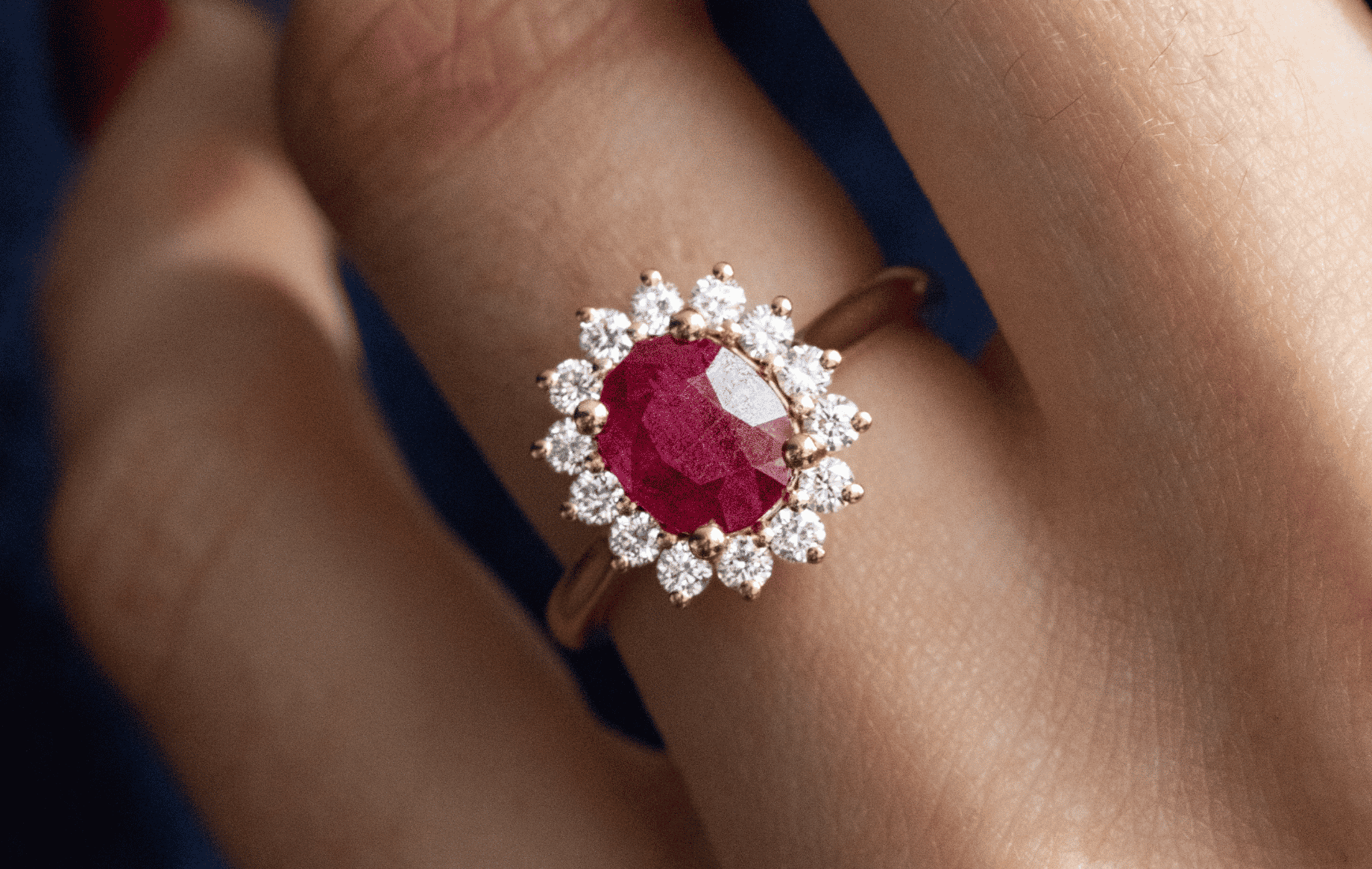
The ring features a magnificent oval-shaped Burmese ruby at its center, weighing approximately 13.26 carats, and surrounded by a dazzling halo of diamonds. On 3rd October 2017, it was sold for a soul-stirring sum of $10.5 million at Sotheby’s auction in Hong Kong.
Mozambican rubies offer broader accessibility. Under 1 carat, Mozambique rubies typically range from $200 to $1,000 per carat, and in the 1–3 carat range, prices can reach $500–$5,000 per carat for high-quality stones. It is important to note, however, that treatment status matters enormously regardless of origin. A fine, untreated 1-carat Mozambique ruby was priced at $9,775 per carat, well above a treated Burmese ruby of similar weight at $3,885 per carat. At the same treatment level, the per-carat price difference between the two origins narrows significantly

The auction record underscores this. In 2015, the Sunrise Ruby, a 25.59-carat Burmese pigeon's blood stone sold for $30.4 million. In 2023, the Estrela de Fura, a 52.22-carat Mozambican ruby, one of the largest from the region ever found, sold for $35 million at Sotheby's in New York in June 2023. This is a prime example of what a pigeon blood red ruby looks like.
The auction market confirms what gemmologists have long known: colour is king, and an exceptional ruby commands its price regardless of whether it emerged from the jungles of Myanmar or the plains of Mozambique.
Ruby Treatment: Heated, Flux-Healed, and Glass-Filled Rubies Explained
To understand ruby treatment, one must first understand the nature of ruby itself. Unlike many gemstones, rubies are almost universally included. They form under conditions of extreme geological pressure, and the same chromium that gifts them their remarkable red colour also creates internal tensions as the crystal grows. The result is that a truly clean, inclusion-free ruby is, in nature, extraordinarily rare.
Inside most rough rubies, a gemmologist will find a complex world of inclusions: fingerprint-like fluid inclusions, crystal fragments, colour zoning, and most characteristically, fine needles of rutile known as silk. In small quantities, silk can enhance a ruby's beauty, scattering light to create a soft, velvety warmth. In larger quantities, it clouds the stone and reduces transparency. Approximately 95% of rubies on the market today have been heat-treated. The trade has developed a hierarchy of treatments, and understanding this hierarchy is essential when purchasing a fine stone.

Iridescent exsolution rutile is oriented in three directions in this Burmese ruby. This “silk” is responsible for creating asterism in gem-quality ruby
Heat Treatment
Heat treatment is the most widely accepted and disclosed form of ruby enhancement. Rubies are heated at temperatures above 1,700 degrees Celsius. The heat dissolves rutile silk needles, making the ruby more transparent, and removes undesirable colour zones, like the blue colour cores found in Mong Hsu rubies, leaving behind a richer, cleaner red.

A hexagonal cloud results from heat treating this Burmese ruby from Mogok.
Silk does not fully recrystallise until somewhere around 1,200–1,600 degrees Celsius, and even at high temperatures may leave characteristic traces due to its high melting point. Rather than the intact intersecting needles of an unheated stone, these dotted or broken rutile needles are exactly what a gemmologist looks for under magnification to confirm treatment.
Heat treatment is considered permanent, stable, and widely accepted throughout the trade. A fine heat-treated ruby will carry a gemmological certificate noting "heated" and commands strong value, but will never reach the price of an unheated stone.
Flux Healing
Many rubies, especially Mozambican Maning Nice material, present a further challenge: heavy fracturing. Here, a more intensive form of treatment comes into play. In the event of cavities that weaken a ruby's durability, the stone is heated in the presence of a flux material, corundum, which fills the cavities and allows the ruby to heal the fractures itself. Rubies are made of corundum, so this flux material is perfect.

Heat treating ruby in the presence of flux can help to heal cracks. It can also leave flux residue trapped inside, as seen in this Mozambican ruby.
The mechanism is elegant: during heat treatment, the molten flux enters the fracture and dissolves the walls of the crack. During cooling, dissolved corundum recrystallises within the crack, healing it closed. In other words, synthetic ruby is grown within the fissure. Some corundum material does not crystalise correctly and forms pockets of residue. Flux-healed rubies are accepted by the trade but command lower prices than cleanly heat-treated stones, reflecting the extent of intervention.
Lead-Glass Filling
The most significant — and most controversial — treatment in the ruby market is lead-glass filling. So-called "glass-filled rubies" began appearing in the trade in the early 2000s, and by 2004 this material had flooded the market. The main objective was to enhance the clarity of otherwise low-quality, semi-translucent to opaque rubies, primarily from Madagascar.

A blue and orange “flash effect” is prominent in this lead-glass-filled ruby.
The process works quite differently from flux healing. Rather than the stone healing itself, the fractures are filled with lead glass. The result can make an otherwise valueless piece of ruby appear deceptively transparent and attractive. These stones are sometimes colloquially called "composite rubies," and in the most extreme cases contain more lead glass by volume than natural corundum. Fracture-filled rubies can be damaged by mild acids or even household cleaners, making them fragile for everyday wear.
Lead-glass filling has a devastating effect on value, and reputable sellers will always disclose this treatment fully. Any ruby offered without a current gemmological certificate from a recognised laboratory (GIA, Gübelin, SSEF, or AGL) should be treated with caution.
Conclusion: Two Origins, One Enduring Fascination
The story of the ruby is, in many ways, the story of human desire itself. For well over a millennium, the mines of Burma's Mogok Valley held an almost mythological status. The source of the world's most coveted red, the stone of emperors and queens, a gem so rare and so perfect that Burmese traders said seeing a true pigeon's blood ruby was like seeing the face of God. That heritage is real, irreplaceable, and continues to command a premium that no other origin can fully match.
Yet in barely fifteen years, Mozambique has rewritten the modern chapter of ruby's history. From a chance discovery in the fields of Cabo Delgado to supplying roughly half the world's rubies by volume, the Montepuez deposit has democratised access to fine rubies in a way that was inconceivable a generation ago, while simultaneously producing stones that have sold at auction for tens of millions of pounds. The Estrela de Fura proved that Africa is not merely a footnote; it is now a chapter of its own.
Whether you are drawn to the warm, luminous glow of an unheated Mogok ruby or to the deep, vivid clarity of a fine Mozambican stone, both origins offer something profound: a piece of the earth's most ancient processes, compressed into a crystal no larger than a grape and saturated with colour that humanity has found irresistible since the Bronze Age.
The key, always, is knowledge: understanding origin, understanding treatment, and working with specialists who can guide you to the right stone for the right purpose with full transparency and provenance.




Need help choosing ?
We're happy to help