12 Feb 2026 — by Flawless Fine Jewellery — Reading time 12 minutes
The 4c’s – Diamond Carat
A guide to diamond carat, exploring weight, size, pricing, and confident diamond choices.
The 4c's - Diamond Carat
What You'll Learn
➤ Diamond carat measures weight using a system derived from carob seeds, where one carat equals 200 milligrams and is divided into 100 points
➤ Higher carat weight increases rarity and cost, but doesn't necessarily mean more beauty or a better choice for your life
➤ The way a diamond appears on your finger depends as much on cut quality and shape as on carat weight itself
➤ The four Cs: carat, cut, colour and clarity work together to create true value and the light you see
➤ Understanding how to balance these elements helps you find a diamond that feels entirely right for you
What Is Diamond Carat?
Perhaps you've heard the phrase "two carats" as though the number tells the whole story. It's a shorthand people use, and it carries weight with it.
But carat weight is just one part of what makes a diamond beautiful and right for your life. Understanding what carat actually means gives you the foundation to make a choice that feels intentional.

Understanding What Carat Actually Means: The Carat System Explained
A diamond's carat weight is its measurement of heaviness. That's the foundation. One carat equals 0.2 grams, remarkably light, actually. The carat system divides each carat into 100 points, which is why you'll see weights written as 1.00 ct, 0.76 ct, or 1.57 ct. This unit of weight is the same whether you're looking at a rough diamond fresh from the earth or a brilliant cut diamond ready to wear.
The word itself has a gentle history. Gem merchants centuries ago would use carob seeds as counterweights when measuring stones by hand. The seeds were fairly uniform in size, reliable in their consistency. It made sense. That practical solution became so embedded in the trade that when the metric system arrived, the carat endured unchanged. Something useful, trusted, lasting.

This precision matters considerably. Even small differences in carat size shift the price noticeably. A diamond weighing 1.00 carat versus 0.95 carat may look almost identical on your finger, yet the price difference can be substantial. Understanding that one carat equals 0.2 grams helps you see that the unit of weight is quite small, which is why larger carat diamonds become exponentially rarer and more valuable.
Every diamond weighs something specific. And knowing how to read that weight, understanding that the carat system is divided into 100 points and that total carat weight includes the measurement of the stone itself, forms the basis of everything else you'll learn about diamonds.
Diamond Carat Weight & Rarity: Why Per Carat Pricing Matters
Heavier diamonds cost more per carat. That's the direct relationship. But it's not a simple one. A two-carat diamond doesn't cost twice what a one carat diamond costs. It costs considerably more. The mathematics of rarity means that as carat size increases, stones become exponentially harder to find. The earth simply produces fewer of them.
This is where understanding the difference between two diamonds of different carat weights becomes important. Two diamonds might both weigh 1.5 carats and yet have entirely different values. Total carat weight tells only half the story. The difference lies in how the stone was cut, its colour, whether inclusions are visible. All of these shift what you're actually paying for per carat, and what you'll experience when you look at the diamond engagement ring on your hand.

There's also a market pattern worth knowing about. A 0.99-carat diamond costs noticeably less than a 1.0-carat stone, even though they look nearly identical. The same happens at 1.5, 2.0, and 3.0 carats. These threshold weights carry psychological significance. They feel like milestones. The larger carat weights command premium pricing. Which means if you don't need that specific number, you can find something genuine and beautiful for considerably less money.
Buying a diamond means understanding that although carat weight matters, it's the total picture of cut quality, colour, clarity, along with the carat size that determines real value.
Actual Size vs Carat Size: Why Your Diamond Will Appear Larger Than You Expect (Or Smaller)
This is where clarity arrives. Two diamonds of identical carat size can look remarkably different in actual size and presence when you see them together. The reason is the cut. This matters for understanding diamond shapes too.
A well-cut brilliant cut diamond bounces light back to your eye with efficiency. It looks bright, it looks alive, it seems to glow. A diamond of the same carat size but cut less thoughtfully might be deeper and narrower. The same heaviness, less light returning. It appears smaller. It appears duller. Yet the carat weight on the certificate would be identical. This is why poorly cut diamonds often disappoint people, and why brilliant cut diamonds can seem to defy their carat size in the best way.
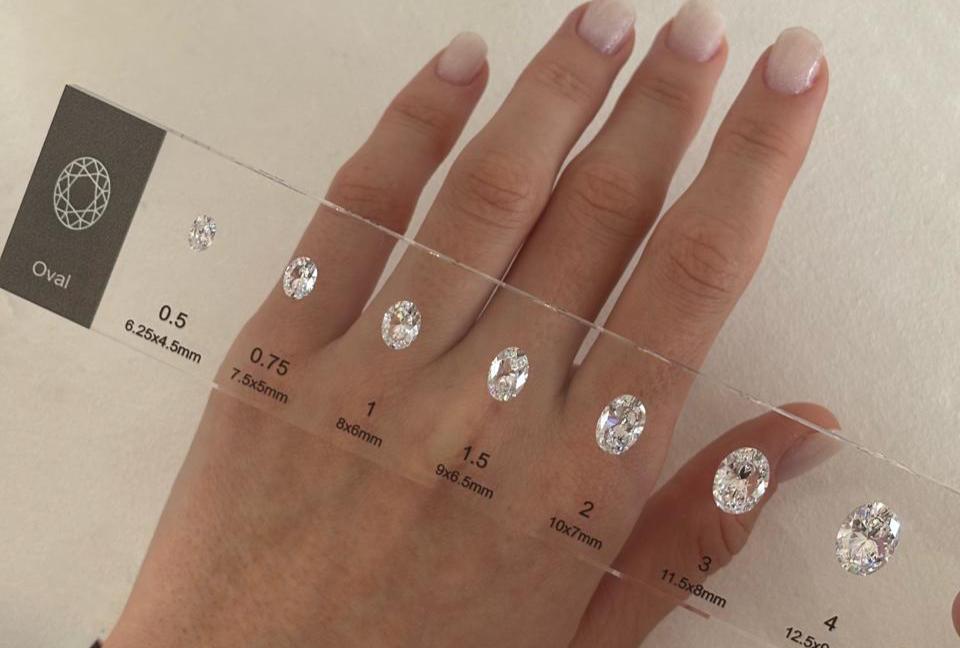
Shape matters here too. An oval diamond naturally spreads its weight across more surface area than a round diamond of the same carat size. Different diamond shapes, a pear or marquise, will read as visually larger because of how the facets are arranged. You get more presence per carat when the shape is elongated. A 1 carat diamond in an oval cut will appear larger on your finger than a 1 carat diamond in a round brilliant cut.
This matters for how you live with the ring. If you want something that feels substantial and sparkles, chasing larger carat weights might not serve you best. You might achieve something far more beautiful by prioritising cut quality instead. A half carat diamond with an excellent cut can outshine a full carat diamond that's been cut with less intention. The actual size difference in how much light reaches your eye is the difference between satisfied and disappointed.

Looking at a diamond solitaire or any diamond in person, before you commit, changes everything. A diamond carat size chart might tell you measurements. Your eyes and your experience tell you whether it's right for your finger, your lifestyle, your actual life.
Carat Diamond Quality: The 4Cs of Diamonds & Knowing What Carat to Choose
When you're choosing a diamond, there are four qualities that matter. Carat, cut, colour, clarity. The 4Cs of diamonds. People sometimes speak about them as though they're equally important, but they're not quite.

Diamond cut is the most influential of these. Cut determines how a diamond performs. It determines whether light dances through it or gets trapped. The cut of a brilliant cut diamond is what makes you look down at your hand and feel something shift. Carat refers to the weight, certainly, but weight alone doesn't create beauty. This is something you need to know about carat when you're making your decision.
If you find two diamonds that weigh the same, the one with the better cut will serve you better every time. It will be brighter. It will look more substantial. You'll prefer it. That's consistent across every carat diamond you might compare.
Colour and clarity matter, though differently depending on the shape. With a round brilliant cut diamond, the faceting pattern is quite forgiving. Imperfections don't read as obviously. But if you're drawn to an emerald cut or asscher cut, the geometry shows everything. Clarity becomes more central to whether the stone looks clear and clean. Colour matters more when there's nowhere for it to hide.
The choice between a 1.5-carat diamond with adequate cut versus a 1.2-carat diamond with excellent cut often favours the smaller stone. The smaller one will make you genuinely happier. That's not compromise. That's choosing the right carat to match your priorities. Understanding the 4Cs means you know how carat doesn't stand alone. You know that carat is just one piece of determining its value.
Buying a Diamond: Finger Size, Personal Style & Choosing with Your Lifestyle in Mind
When you're ready to choose, there are a few things that shape the experience, and they extend beyond just the numbers on a diamond carat size chart.
Set a budget first. Not to restrict yourself, but to anchor yourself. Once you know what you're comfortable spending, everything else becomes clearer. You're not searching endlessly. You're searching purposefully within a space that feels right.
Then think about what matters to you practically. Not what's supposed to matter. What actually matters to your life. Do you want something that feels substantial and impressive. Do you want it to sparkle more than anything around it. Do you have a specific carat weight in mind, a round number that feels significant to you. Or do you simply want something beautiful that makes you happy every time you glance down. Consider your finger size too. Finger size affects how diamonds appear. The same carat diamond will look different on different hands.
Think about your lifestyle. Are you someone who uses your hands a lot, who might want a smaller, more secure setting. Are you someone who wants maximum presence and visibility. These questions have different answers for different people. All of the answers are valid.

Once you know what you're drawn to, you can make intentional trade-offs. If you want maximum carat size, you might accept a colour that's slightly warmer, or clarity that's good rather than flawless. You're not making mistakes. You're making choices based on what matters to you. You're buying a set of priorities aligned with your values and your life. Whether you're drawn to natural diamonds or choosing lab grown diamonds, the same principles apply.
At Flawless, we work with you through this process. Our personalised consultations cover diamond education so you understand what you're actually looking at. We help you see how cut quality and carat size interact. We show you different diamonds of different weights and cuts so you can feel the difference yourself, rather than imagining it. We think practically. We work with your lifestyle, your personality, your finger size, your personal style. We help you find something that feels entirely yours, whether that's yellow gold with a brilliant cut diamond or any other configuration that speaks to you.
Get a certified grading report from the Gemological Institute of America (GIA) for any diamond you're genuinely considering. This isn't a formality. It's your assurance that the measurements are accurate, that you know exactly what you're purchasing. It's your baseline.
And always see the diamond before you decide. Hold it in your hand. Look at it in different light. Feel how it moves. A diamond jewellery purchase is significant. A certificate is factual. Your experience of the stone is what matters.
Key Thoughts: Everything You Need to Know About Diamond Carat Weight
One carat is equal to 0.2 grams. The measurement came from carob seeds, which is rather lovely. It's precise, it's consistent, and everyone uses the same carat system across the industry.
Larger carat diamonds means rarer, which means more expensive. But rarer doesn't automatically mean better or more suitable for you. That's the piece that shifts everything about how you approach the choice. Although carat weight matters for determining its value, it's not the only factor.
How large a diamond will appear on your finger depends on cut and shape just as much as it depends on carat size. Sometimes more. A well-cut smaller stone can feel more present than a larger diamond that's been cut with less intention. Although carat weight tells you heaviness, it doesn't tell you how the stone will look.
The 4Cs work as a system. Carat weight should be balanced with diamond cut, colour, and clarity according to what feels important to you. Most people find that prioritising cut creates the most satisfaction. Carat doesn't determine beauty alone. The interaction of all four factors does.
Sometimes your best choice is actually a diamond lighter than you initially expected, because the cut makes the light dance the way you hoped. That's not compromise. That's wisdom. Carat size to choose depends entirely on how you want to live with the ring.
A diamond's weight of 0.5 carats versus 1 carat versus 2 carats: these different carat weights create very different experiences. How a diamond weighs affects its rarity, but not necessarily its beauty.
Always request certification from the GIA. Always see it in person. The choice should feel entirely intentional, entirely yours. Your finger size, your lifestyle, your personal preferences. All of these shape what the right carat actually is.
FAQ's
What exactly does carat weight measure?
It's the heaviness of the diamond. One carat is equal to 0.2 grams. The word comes from carob seeds, which traders used as counterweights centuries ago. The carat system divides each carat into 100 points, giving remarkable precision. Understanding that carat refers to the weight helps you interpret what you're actually looking at.
Why does a 1.0-carat diamond cost so much more than a 0.99-carat?
Carat thresholds carry psychological significance. A full carat feels like a milestone. The market reflects that. Diamonds at those round weights (1.0, 1.5, 2.0, 3.0) command premium pricing. Different carat weights at these thresholds can cost dramatically differently. Which means if that specific number doesn't matter to you, you can find something genuine and beautiful for considerably less money.
Does higher carat weight mean the diamond will look larger?
Not necessarily. Although carat weight matters, diamond cut and shape matter as much, sometimes more. An oval diamond of one carat will appear larger than a round-cut diamond of the same carat size. A poorly cut larger diamond might look smaller and less bright than a beautifully cut lighter stone. A diamond carat size chart shows you the measurements, but your eyes tell you the actual size.

How do I know I'm paying fairly for a diamond's carat weight?
Request a GIA grading report. It documents the exact weight and the quality grades. Compare prices across several diamonds with different carat weights and specifications. Two diamonds of identical carat weight can cost very differently depending on diamond cut, colour, and clarity. The report is your anchor for understanding value per carat.
Should I prioritise carat weight or diamond cut quality?
Cut quality tends to create more visible satisfaction. A smaller diamond with excellent cut will likely make you happier than a larger diamond with mediocre cut. A brilliant cut diamond shows this most clearly. The beauty you experience comes from cut. Carat is the weight. Choose the right carat for your priorities, not the largest carat possible.
What's the difference between carat and karat?
Carat measures the weight of gemstones. Karat measures the purity of gold. An 18K gold ring contains 75% pure gold. Different measurements entirely, though easily confused because of the similar sound. When you're buying diamond jewellery, you need to know both: the carat weight of the diamond and the karat of the gold.
Can I see a meaningful difference between a 0.5-carat and a 1.0-carat diamond?
Yes, there's a noticeable difference in how much visual presence each has. But it's less dramatic than many people expect. Diamond cut, shape, and even the setting affect how large it appears. The best way to understand the difference is to look at them side by side in person, under natural light and indoor light both. Seeing diamonds together changes how you understand carat size entirely.




Need help choosing ?
We're happy to help