28 Jan 2026 — by Flawless Fine Jewellery — Reading time 12 minutes
The Radiant Cut Guide
Learn what makes radiant cut diamonds unique, from proportions to value, settings, and ring design
The Radiant Cut Guide
What You'll Learn
➤ Why radiant cut diamonds deliver the brilliance of a round with the bold geometry of an emerald cut
➤ How to identify ideal proportions and length-to-width ratios that define a well-cut radiant diamond
➤ The unique faceting structure that makes radiant cuts more forgiving with clarity and colour grades
➤ How to select settings that amplify the architectural presence of a radiant cut diamond
➤ Why radiant diamonds offer exceptional value compared to other premium diamond shapes
There's a particular kind of confidence that comes with knowing exactly what you want. Not what's expected. Not what's trending. Just clarity about what feels right.
That's where radiant cut diamonds live. They don't announce themselves with vintage whispers or contemporary minimalism. Instead, they occupy this rare space between tradition and modernity, between soft romance and geometric precision. A radiant cut diamond doesn't ask you to choose. It gives you both.
For couples drawn to diamonds that feel substantial without being predictable, the radiant cut diamond makes sense. It's got the fire and brilliance you expect from a classic stone, but the shape itself refuses to blend in. Seventy facets working together. Cropped corners that catch light from unexpected angles. A silhouette that sits somewhere between emerald and cushion cuts but doesn't commit to either.

This isn't about what everyone else is buying. This guide covers what actually matters when you're choosing a radiant cut diamond engagement ring, the proportions, the grading priorities, the settings that let the stone breathe. The kind of information that helps you make a decision you'll still love for a lifetime.
Topics Covered:
What makes radiant cut diamonds different
Henry Grossbard created the radiant cut in 1977. The innovation wasn't complicated, he just combined two things that hadn't been put together before. The brilliance of a round diamond. The clean, geometric outline of an emerald cut.
What came out was a diamond shape with 70 facets arranged in a modified brilliant pattern. Exceptional light performance. Sharp, geometric lines. Both at once.
Before radiants, you chose between sparkle or shape. Round brilliants offered maximum fire but conventional form. Emerald cuts gave you architectural drama but muted brilliance. The radiant diamond bridged that gap entirely.

Why the faceting structure Matters
Those 70 facets aren't decorative. They work.
The pavilion, bottom half of the diamond, uses brilliant-cut faceting. Same arrangement you'd find in a round. That's where the light return happens. The flashing. The moving sparkle that makes diamond rings feel alive.
The crown, top half, mixes step-cut with brilliant-cut faceting. Hybrid approach. Light enters the stone, bounces through the pavilion, shoots back to your eye with real intensity. You get a diamond that performs like a round brilliant but looks completely different.
The cropped corners do two things. Structurally, they protect against chipping, practical advantage over sharp-cornered cuts like princess or emerald. Visually, they soften the silhouette just enough. Approachable without losing boldness.
A Shape that strikes balance
Radiant cuts occupy their own category. They're not vintage like cushions. Not contemporary like princess cuts. They carry weight without severity. Elegance without fragility. That duality is exactly why they appeal to people who don't want their engagement ring to feel like it belongs to someone else's story.
This shaped diamond offers something genuinely unique: a perfect choice for couples who want a timeless style without feeling traditional. The beauty lies in that tension, that refusal to be easily categorised.
Understanding radiant cut proportions and ratios
Not all radiant diamonds are cut equally. Proportions decide whether your stone looks balanced or awkward. Whether light moves through it properly or just dies in the centre.
Finding your ideal lenght-to-width ratio
Radiant cuts exist across a wide range. Square radiants usually sit between 1.00 and 1.05 in length-to-width ratio. Rectangular radiants? They span from 1.15 to 1.50. Most people land around 1.25 to 1.35.
Square radiants feel bold and architectural. They command attention without needing size. The symmetry reads as confident, grounded. Rectangular radiants elongate the finger and carry a softer, more romantic presence. The rectangular shape allows for stunning displays of light that move differently across the stone.
Depth and table percentage that work
Depth percentage should fall between 61% and 67%. That range keeps light moving through the stone the way it's supposed to entering through the crown, bouncing off the pavilion facets, coming straight back to your eye. Too shallow? Brilliance fades.
Too deep? The diamond looks dark from above.
Table percentage (the size of the top facet relative to the diamond's width) should sit between 61% and 69%. Larger tables let in more light but can reduce fire. Smaller tables enhance dispersion, that rainbow flash. but can feel visually heavy if taken too far.
These aren't arbitrary numbers. They're the result of decades of optical research into how light behaves inside faceted gemstones. When a radiant diamond sits within these parameters, it performs as intended.

Why cut quality matters more than grade
Unlike round brilliants, fancy shapes like radiants don't receive official cut grades from gemological labs. Instead, you rely on symmetry and polish ratings. Excellent or very good symmetry means the facets align precisely, that light moves evenly across the stone. Poor symmetry interrupts light return and creates dead zones where sparkle disappears.
Polish affects surface brilliance. Excellent polish gives you a smooth, reflective surface that maximises light entry. Anything less and you're compromising performance for no reason.
Expert cutters understand this. The combination of proper depth, table percentages, and symmetry creates a radiant cut diamond that feels alive under any lighting condition.
Grading priorities: Where to Invest and where to save
The Four Cs all matter, but radiant cuts handle certain grades differently than other shapes. Understanding where you can save without compromise changes what your budget actually buys.
Clarity: The radiant's hidden advantage
Radiant cuts are forgiving with clarity. All those facets, the brilliant-cut pavilion, the complex light movement, they mask inclusions beautifully. What would be visible in an emerald cut disappears entirely in a radiant.
For natural diamonds, VS2 to SI1 offers the best value. For lab-grown diamonds, VVS2 to VS1 keeps costs reasonable while maintaining eye-clean stones. Eye-clean means no visible inclusions without magnification. That's the standard that matters.
Check inclusion placement on the grading report. Inclusions near the edges or under the crown facets stay hidden. Inclusions directly under the table or in the centre become more noticeable. Location matters as much as grade.

Colour: How metal changes everything
Radiant cuts show colour more than round brilliants but less than emerald cuts. Their brilliant faceting disperses light in ways that dilute faint colour.
For platinum or white gold settings, aim for G or higher to maintain a truly colourless appearance. The cool tone of these precious metals amplifies any warmth in the diamond. For yellow or rose gold, you can comfortably drop to H or I. Warm metals hide warm tones naturally, and the contrast often feels intentional rather than compromised.
According to gemological research, most people cannot distinguish colour differences of one or two grades when diamonds are set in jewellery. That H-colour radiant in rose gold reads as white because context matters more than grade.
Yellow and white gold both offer beautiful backdrops, and the choice comes down to personal style and how you want the stone to read against your skin tone.
Carat weight and visual presence
Radiant cuts carry their weight differently than rounds. A one-carat radiant looks larger than a one-carat round because of how the shape spreads surface area. More diamond facing up. More visual impact for the same carat weight.
That means you've got options. Go larger within budget. Or prioritise cut quality and still get the presence you're after. A well-cut 1.5-carat radiant? It'll outperform a poorly-cut 2-carat stone. Both in brilliance and how big it actually looks.
Designing your radiant engagement ring: Settings that work
A radiant diamond needs a setting that understands its geometry. The wrong mounting diminishes the shape's boldness. The right one amplifies everything the cut was designed to deliver.
Settings that honour the shape
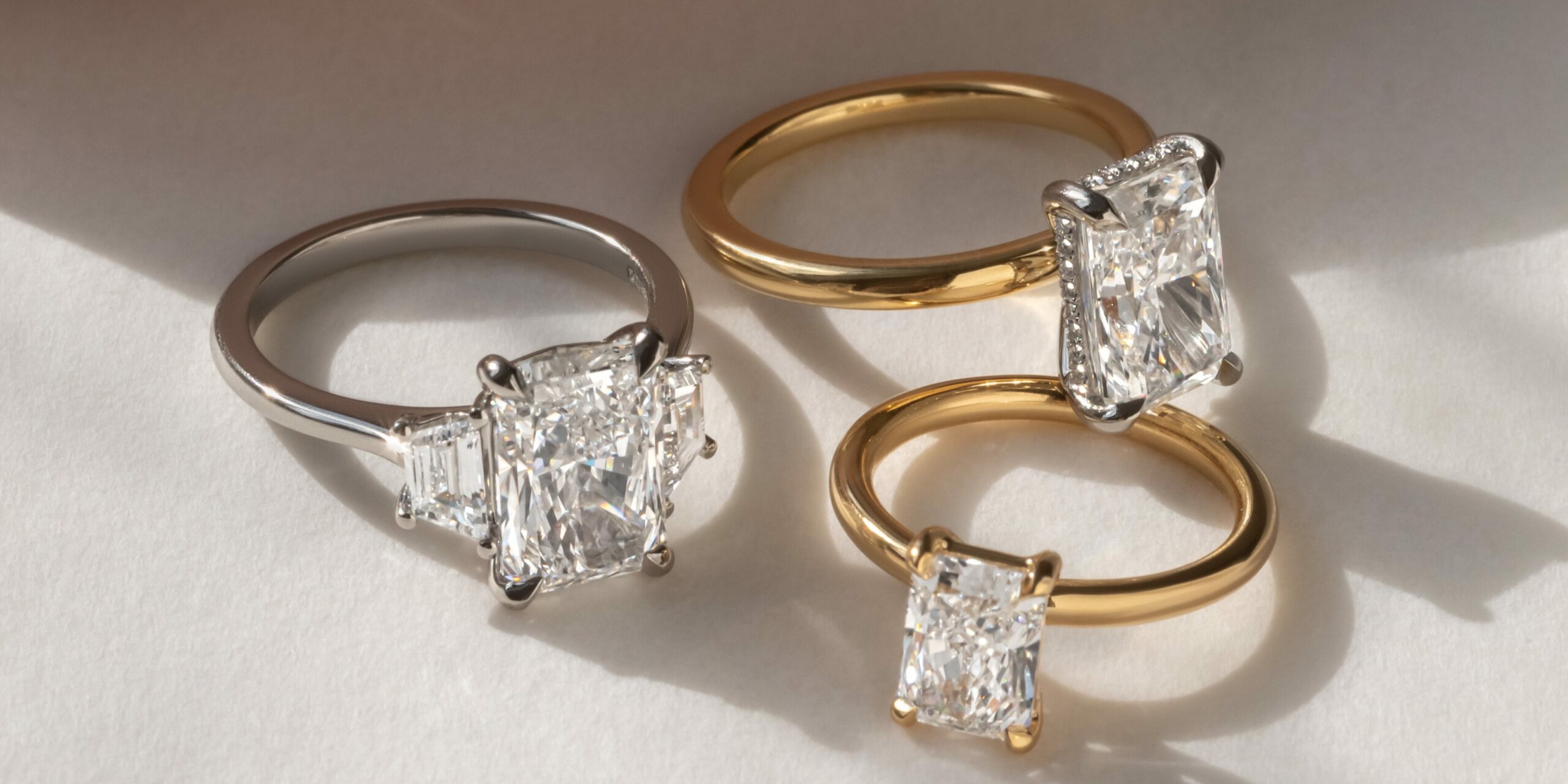
Solitaire settings let the radiant diamond do the talking. Four-prong or double-prong mountings work beautifully, they secure those cropped corners while keeping everything clean. Platinum or white gold? Contemporary. Yellow gold brings warmth, that vintage resonance you'd associate with classic engagement ring styles.
Three-stone designs frame the radiant with smaller diamonds or coloured gemstones. Baguettes or tapered baguettes echo the radiant's geometry without competing for attention. The symmetry feels deliberate. Balanced.
Halo settings multiply visual impact. A diamond halo, a frame of smaller round brilliants or matching radiants, increases perceived size and adds architectural depth. This works especially well for square radiants, where the halo reinforces the shape's boldness rather than competing with it.
The range of setting options allows couples to discover their perfect piece without compromise.

Band considerations
The band should echo the diamond's proportions. Rectangular radiants pair well with slightly narrower bands that emphasise length. Square radiants can handle more substantial bands without visual imbalance.
Texture matters. Twisted bands, engraved patterns, or knife-edge profiles add dimension without distraction. The goal is supporting the diamond, not introducing competing elements. You're wearing this every day. The setting should feel like an extension of the stone, not a separate piece demanding attention.
For those looking to shop with flexibility, many jewellers now offer finance options that make investment in quality more accessible without compromising on the features that matter most.
Radiant diamonds and value: What you're actually getting
Radiant cuts offer genuine value within the diamond market, and understanding why helps you make informed decisions about where to allocate budget.
Pricing compared to other shapes
Radiant diamonds typically cost 10-30% less per carat than comparable round brilliants. The difference comes down to rough diamond yield. Cutters lose less material when creating radiants compared to rounds, and those savings transfer to buyers.
You're getting a diamond with the brilliance and fire similar to a round brilliant but paying meaningfully less for equivalent quality. That price difference lets you either go larger or invest in better colour and clarity grades within the same budget.
When you explore radiant engagement rings, you'll discover this value proposition makes a real difference, especially when shopping online where you can compare certified stones across a wide selection.
Lab-Grown vs Natural: A legitimate choice
Lab-grown radiant diamonds are chemically, physically, and optically identical to mined diamonds. Same carbon crystal structure. Same refractive index. Same brilliance.
The only difference is origin. One formed in Earth's mantle over billions of years. The other in a controlled lab over weeks.
Lab-grown diamonds cost 60-80% less than natural equivalents. That opens up options that might otherwise sit outside budget. If a two-carat natural radiant feels financially unrealistic, a two-carat lab-grown radiant delivers identical visual impact and durability. Fraction of the cost.
Neither choice is morally superior. It's about what matters to you. Geological rarity or accessible luxury.
Both are real diamonds. Both will last lifetimes. Many customers now select lab-grown options specifically because they can invest more in cut quality or setting design.

Long-term wearability and beauty
Radiant cuts are practical. The cropped corners resist chipping better than sharp-cornered princess or emerald cuts. The brilliant faceting hides normal wear, minor surface scratches, better than step-cuts. Radiants maintain their appearance through daily life without demanding obsessive care.
The shape itself has staying power. Created in the 1970s, radiants have spent nearly fifty years proving they're not a trend. They've become a permanent part of diamond cutting tradition because they solve real problems: delivering brilliance, architectural presence, and durability in one shape.
For UK customers and beyond, the radiant cut diamond represents not just beauty but sensible design not just beauty but sensible design a perfect engagement ring for couples at any stage of their journey together.
Key Takeaways
➤ Radiant cut diamonds combine round brilliant fire with geometric, sophisticated form through 70 precisely arranged facets.
➤ Square radiants (1.00–1.05 ratio) feel bold and contemporary; rectangular radiants (1.25–1.35) elongate the finger with romantic presence.
➤ Ideal depth sits between 61–67%, with table percentages between 61–69% for optimal light performance.
➤ Radiant cuts mask inclusions beautifully, making VS2–SI1 clarity grades excellent value without visible compromise.
➤ The shape costs 10–30% less than comparable round brilliants while delivering similar brilliance and larger visual presence.
➤ Lab-grown radiants offer identical quality and appearance at significantly lower cost, expanding options within budget.
➤ Settings should honour the radiant's geometry: solitaires, three-stone designs, and halos all work when proportions are balanced.
➤ Yellow gold, white gold, and platinum each create different visual effects that change how the stone appears.
➤ Finance options and online shopping make exploring a wide array of certified diamonds more accessible.
➤ Flawless delivery and in-store viewing allow customers to confirm their choice before committing.
Choosing a radiant cut diamond says something about how you see yourselves. It's a shape that refuses to choose between sparkle and structure, between boldness and elegance. It holds both without apology. That confidence, knowing what you want and why, transforms a beautiful stone into something genuinely meaningful. The radiant cut diamond is the perfect.
FAQ's

Is radiant cut diamond more expensive?
No. Radiant cuts cost 10–30% less per carat than round brilliants of comparable quality, placing them in a similar price range to princess, cushion, and oval cuts. This makes radiant cut engagement rings excellent value, you get exceptional brilliance and a larger-looking diamond without the round brilliant premium. The geometric shape retains more rough diamond during cutting, and lower demand compared to rounds keeps prices competitive while delivering outstanding sparkle.
How much is a 2 carat radiant cut diamond?
A 2.00 carat radiant cut diamond typically ranges from £4,500–£20,000+ depending on colour, clarity, and cut quality. For excellent specifications (G–H colour, VS2–SI1 clarity, ideal proportions), expect £9,000–£14,000. Lab-grown radiant diamonds of this size cost £2,800–£6,000, offering substantial savings. Always verify depth (61–67%), table (61–69%), and symmetry ratings, and view the stone to ensure even light performance with no dead zones.
How big of a diamond can I get for $20,000?
With a £16,000–£20,000 budget (roughly $20,000), you can expect a stunning 2.50–3.50 carat radiant cut mined diamond with excellent quality (F–G colour, VS1–VS2 clarity, ideal proportions). If choosing lab-grown, that same budget delivers an exceptional 4.00–6.00 carat radiant cut with premium specifications. Radiant cuts maximise your budget because they face up larger than rounds and cost significantly less per carat while delivering comparable brilliance.
What is the cheapest cut of a diamond ring?
Emerald and Asscher cuts are typically the least expensive diamond shapes, costing 20–40% less than round brilliants. These step-cut diamonds retain the most rough diamond during cutting and have lower market demand. Radiant cuts sit in the middle range, more affordable than rounds but slightly more expensive than emeralds because their brilliant faceting requires more precision cutting. For maximum value with exceptional sparkle, radiant cuts offer the best balance of affordability and fire.
What are the cons of radiant cuts?
Radiant cuts lack an official GIA cut grade, requiring manual evaluation of proportions (depth 61–67%, table 61–69%) and visual inspection for light performance. Some radiants show a subtle bow-tie effect across the centre, though typically less pronounced than in ovals. The brilliant faceting can reveal more colour than rounds, so aim for G–H or higher in platinum or white gold settings. Cut quality varies significantly between stones, always view video or see the diamond in person to ensure even brilliance with no dead zones.
Can a jeweler identify a lab-grown diamond?
Not with the naked eye. Lab-grown and mined radiant cut diamonds are chemically, physically, and optically identical. Professional gemologists require specialised equipment to detect microscopic growth patterns that differentiate them. Reputable lab-grown diamonds come with certification clearly stating their origin. The practical difference is price, lab-grown radiants cost 60–80% less than mined diamonds of identical quality, making larger carat weights and higher grades accessible without compromising on brilliance or durability.
Is a VS1 or VS2 better for radiant cuts?
VS2 offers excellent value for radiant cut diamonds. Both VS1 and VS2 are "eye-clean" (inclusions invisible without magnification), but radiants' brilliant faceting effectively masks minor inclusions, making VS2 perfectly suitable for most buyers. Save the difference and invest in better colour (G vs. H) or a slightly larger carat weight instead. Only consider VS1 or higher if you're purchasing a very large radiant (3.00+ carats) where inclusions become more visible, or if you've viewed the specific VS2 and noticed visible inclusions.




Need help choosing ?
We're happy to help