9 Mar 2026 — by Flawless Fine Jewellery — Reading time 12 minutes
Marquise Cut Diamond Guide
Marquise Diamond Guide: Everything You Need to Know
Marquise Cut Diamond Guide
What You'll Learn
➤ Where the marquise cut comes from, and why that history still feels relevant today
➤ Which proportions tend to produce the most balanced, beautiful stone
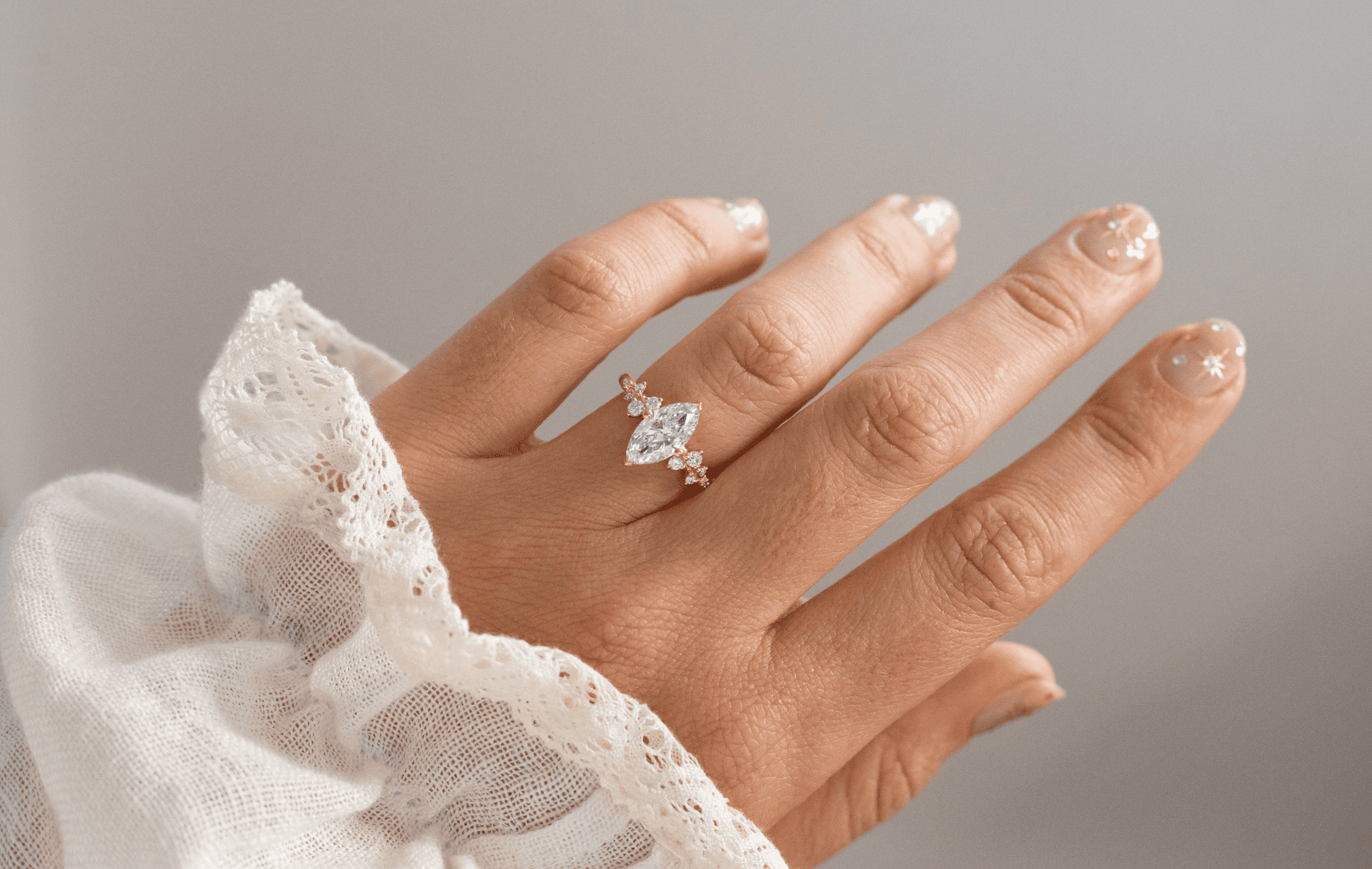
➤ How the elongated silhouette can flatter the hand and create the illusion of greater size
➤ Which settings work well with the marquise's distinctive pointed ends
➤ How to approach colour and clarity so the stone performs beautifully on the hand
Introduction
Some shapes ask to be noticed. Not loudly, not with any effort at all, but with a quiet insistence that stays with you after you've seen them. The marquise is one of those shapes. Two pointed ends, an elongated form, a silhouette that sits on the hand unlike anything else. If you find yourself drawn to a ring with real history behind it, one that feels arrived at rather than simply picked, this marquise cut diamond guide is a good place to begin.
It's not a ring for everyone. That, perhaps, is exactly the point.

Topics Covered:
- The history and romance behind the marquise shape
- Proportions that matter: Length-to-width ratio, depth and the bowtie effect
- Why the Marquise shape can be so flattering to wear
- Choosing a setting that suits both the stone and your lifestyle
- Colour, clarity and where to focus your attention
- Key Takeaways
- FAQ's
The History and Romance Behind the Marquise Shape
Most diamond cuts don't have a story. This one does.
King Louis XV of France is said to have commissioned a stone cut to mirror the lips of his mistress, the Marquise de Pompadour, a detail with enough romance to it that historians have been repeating it ever since, as noted by the Gemological Institute of America. She was sharp, quietly powerful, and the kind of person whose presence tended to stay in a room long after she'd left it.
Whether the origin has softened into something more cinematic over the centuries is almost beside the point. What remains is this: the cut was made in someone's honour. Shaped around the idea of a particular kind of person. That intention has never quite left it and if you're drawn to this shape, you may find that says something about you too.

The name itself, marquise, refers to a rank of French nobility. Between duke and count. A distinction associated less with grand display and more with a certain refinement. Known for character, not just standing. It suits the cut remarkably well.
Today the shape is seeing a genuine return. Couples who find the round brilliant a touch too familiar, who want something with more depth to it than a clean and conventional choice, have been quietly gravitating back here. There is something to the marquise that other shapes don't quite replicate.
Proportions That Matter: Length-to-Width Ratio, Depth, and the Bowtie Effect
Cut for brilliance, the marquise is faceted to catch light from multiple angles and return it with real warmth. The elongated form does bring a few things worth knowing about though. Especially before you fall for a particular stone.
Length-to-width ratio
The relationship between the flat upper surface of a diamond and its overall depth determines how light moves through the stone, how it enters, how it travels, how it comes back out.
Table and depth
Most well-balanced marquise diamonds sit in a ratio where the length is roughly twice the width. Your personal preference plays into this, and so does the hand the ring will live on. A well-proportioned stone holds its characteristic elegance naturally. A specialist can help you find the ratio that feels right once you're actually looking at stones in person, which always tells you more than reading about it.

The bowtie effect
Almost every marquise diamond shows some version of this: a soft, dark shadow across the centre of the stone, shaped, as the name suggests, like a bowtie. It is a natural consequence of the geometry, not a flaw. A faint one is entirely to be expected. A strong, heavy one can suggest the proportions are working against the stone rather than with it. This is one of those things photographs flatten or miss entirely, seeing the stone move, in person or through detailed video, changes everything.
Symmetry
Look at the two pointed ends. They should mirror one another precisely when the stone is viewed from above. Even a small difference between the two sides can subtly shift the way the ring reads on the hand.
Why the Marquise Shape Can Be So Flattering to Wear
Ask someone who wears a marquise cut diamond what surprised them most and the answer is often the same. Not how it looks on a tray. Not in a photograph. How it looks on their hand, in movement, in ordinary light.
Put it on your finger and something becomes clear quite quickly. The shape follows the length of the finger rather than sitting across it, and that creates a line that can make both the hand and the stone appear longer and more slender. It's easier to see than it is to describe. But once you've seen it, you tend to notice its absence on every other shape.

There is something else worth knowing. The marquise carries one of the larger face-up surfaces of any cut for its carat weight. On the hand it can read as considerably more present than other stones of a comparable size. If presence matters to you, this shape tends to deliver it quietly and without effort.
Day-to-day, a well-set marquise is a comfortable ring to live with. Set close to the finger with proper protection at the tips, it moves with your hand rather than against it. It doesn't catch. It doesn't need adjusting. It suits someone who wears their ring through everything and wants it to look deliberate without requiring constant thought.
There is a particular kind of person this ring tends to find. Someone whose style has a natural ease to it. Who moves between different parts of their life with the same quiet confidence. Who wants a ring that says something. without needing to announce it.
Choosing a Setting That Suits Both the Stone and Your Lifestyle
The pointed ends of a marquise are its most defining feature. They're also its most delicate points. How the stone is set matters as much for protection as it does for how the ring looks, and the two are more connected than most people expect.
V-tip prongs are the most widely used choice for this shape, and with good reason. Each pointed end sits in its own small V-shaped claw, held securely without covering the silhouette. The tips stay visible. The shape reads clearly. If you want the marquise to look like itself, this is usually where you start.

Bezel settings wrap the diamond in a continuous band of metal, enclosing it fully. It's a cleaner look, quieter in character. Less romantic, more architectural. It tends to suit someone whose hands are rarely still, or someone who simply gravitates towards jewellery that doesn't announce itself.

Halo settings surround the marquise with a row of smaller stones. More brilliance, more presence. Paired with a vintage-inspired band this can produce something genuinely beautiful, something that feels considered rather than assembled. If you want the ring to fill a room in the way the Marquise de Pompadour herself might have, this is a direction worth exploring.

East-west orientation turns the stone on its side, setting it horizontally across the finger rather than along it. Unexpected. Sculptural. The ring reads very differently from a traditional setting and has attracted real interest from those who want something unmistakably modern without losing the character of the shape.

Metal shapes the feeling of the whole ring. Yellow gold is warm, historically resonant, and brings out a softness in the marquise that suits the shape's origins well. Platinum and white gold push the brilliance forward and feel cleaner, more contemporary. Rose gold sits in its own space, distinctive, gentle, and less commonly seen.
Colour, Clarity and Where to Focus Your Attention
Here is something worth knowing about the marquise specifically: elongated cuts hold colour differently to round brilliants. The pointed ends can concentrate any warmth in the stone in a way that is more visible than in other shapes. Colour is worth thinking about carefully here, perhaps more so than with other cuts.

Colour
Diamond colour runs on a scale from D, colourless, through to Z. For a marquise, stones in the near-colourless range tend to wear beautifully, with any warmth distributed in a way that reads well on the hand. In yellow or rose gold settings the whole context shifts, so a slightly warmer stone can look entirely intentional, even lovely, where the same stone in platinum might read differently. Seeing several stones side by side with a specialist will tell you far more than reading about grades ever could.
Clarity
The brilliant faceting of a marquise disperses light across the stone in a way that can make a wide range of clarity grades appear perfectly clean to the naked eye. As the GIA's diamond quality framework makes clear, clarity is assessed under magnification, conditions that have very little to do with how a diamond looks on a living, moving hand. Eye-clean stones exist across a broader range of grades than most people expect. Seeing is believing, and a specialist can show you what that actually means in practice.
The principle that tends to hold true for this shape: colour has a more visible effect on a marquise than clarity does. A stone with good colour and a well-executed cut will perform beautifully on your hand. A specialist can walk you through the rest when you're ready.
Key Takeaways
• The marquise cut has centuries of intention behind it. It was shaped around the idea of a particular kind of person, and if you're drawn to it, that may say something about you too.
• Proportion shapes everything with this cut. A well-balanced stone reads with a natural elegance that is immediately apparent on the hand.
• The elongated silhouette can make both the stone and your hand appear longer. Face-up, it tends to read larger than other shapes of a comparable weight.
• V-tip prongs protect the pointed ends without obscuring the shape. Whether the stone sits vertically or east-west changes the entire character of the ring.
• Colour tends to have a more visible effect on a marquise than clarity. Both are worth seeing in person with someone who knows these stones well.
There's a moment in the process when a ring stops being something you're considering and becomes something you can't imagine not having. For a lot of people, the marquise is that moment.
FAQ's
Is the marquise cut still a popular choice for engagement rings?
It has been quietly but noticeably coming back. People who might have defaulted to a round brilliant a few years ago are pausing on this shape now, drawn to something that feels a little less expected. The history helps. So does the way it sits on the hand. And there is something about a ring with a genuine point of view that resonates with couples who feel the same way about themselves.
Does a marquise diamond appear larger than a round of the same carat weight?
It can. The elongated shape carries one of the larger face-up surface areas of any cut relative to its weight, which often means it reads as more substantial on the finger than other shapes of a comparable size. If you want presence on the hand, this is one of the more generous cuts for it.
What is the bowtie effect in a marquise diamond?
A soft, dark shadow across the centre of the stone, shaped like a bowtie, caused by the way light travels through the cut's geometry. A faint version is entirely normal and tends to disappear in everyday wear and movement. A heavy or prominent one may suggest the proportions aren't working at their best. Seeing the stone in person or through detailed video makes this far easier to assess than any photograph will.

Which setting works best for a marquise cut diamond?
V-tip prongs are the most widely used choice, securing each pointed end individually while keeping the silhouette clearly visible. A bezel setting offers greater coverage and a more contemporary look. The right answer always depends on the wearer, your lifestyle, your aesthetic, and how you carry a ring day to day.
How should I think about colour and clarity for a marquise diamond?
Colour tends to have a more visible effect on this shape than clarity, particularly at the pointed ends. Stones in the near-colourless range generally wear well, though the metal you choose influences how colour reads in context. Seeing several stones together with a specialist will tell you more than any grading report. It's one of those things that makes much more sense once you've seen it.
Can a marquise diamond be set east-west?
Yes, and it produces a genuinely different ring. The stone sits horizontally across the finger rather than along it, giving the piece a sculptural, architectural quality. It's become a popular choice for those who want something unmistakably modern without losing the character of the shape.
Is a marquise cut well-suited to shorter fingers or broader knuckles?
It can be a particularly good fit. The elongated silhouette draws the eye along the finger rather than across it, which tends to suit a wider range of hand shapes than rounder cuts do. It's worth trying on as most people are surprised by how well it wears.




Need help choosing ?
We're happy to help